“Cathy? Have You Seen My Zibaldone? It Was Here a Minute Ago . . .”

April 22, 2024

Forty-Eight Hours to Lift Off

“Observe the light. Blink your eye and look at it again. That which you see was not there at first and that which was there is no more.” 

Leonardo da Vinci

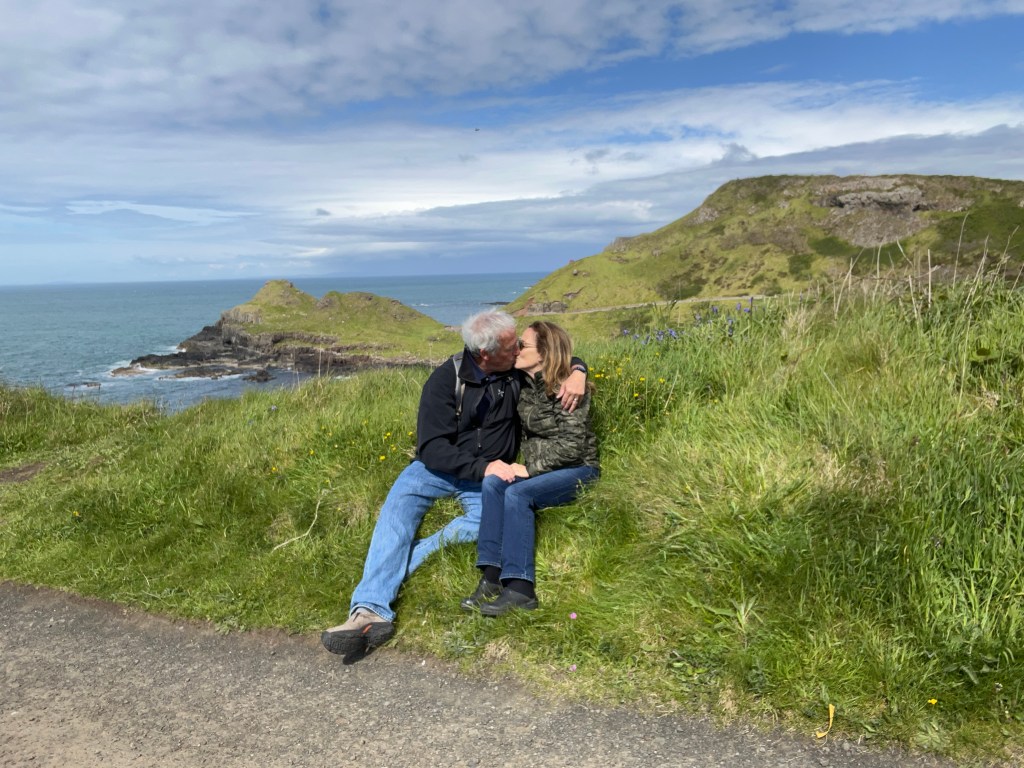
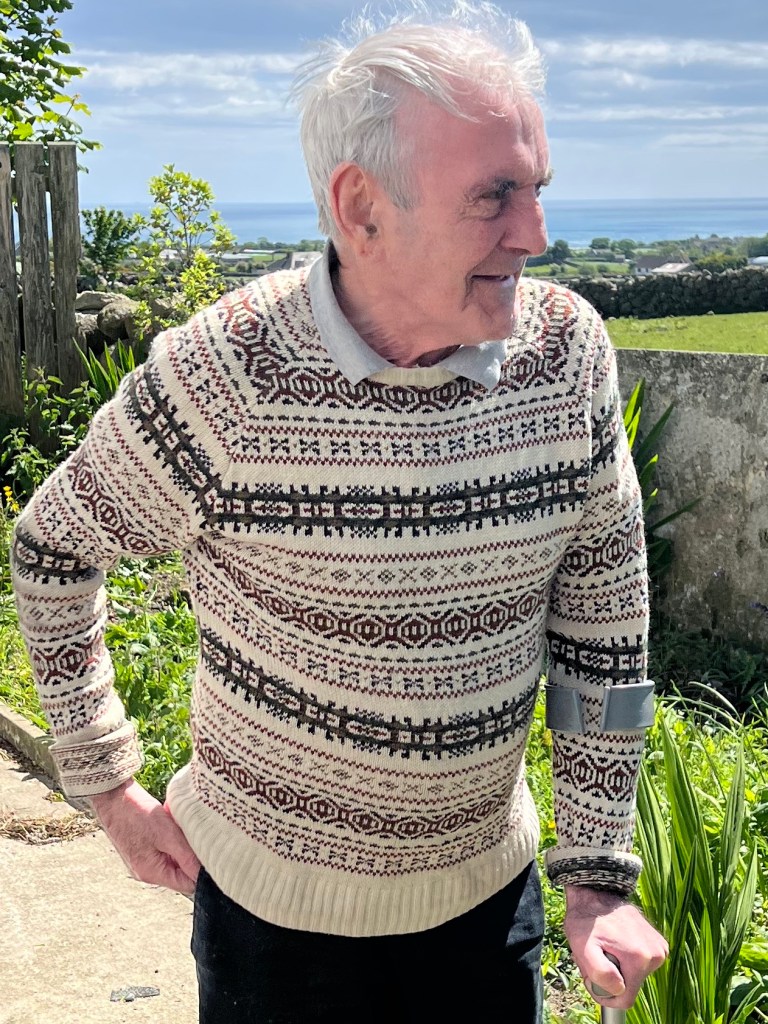
That’s me on the right.

I have been thinking a lot lately and I’m beginning to wonder if it is a worthwhile endeavor. Thinking, that is.

Does it ever strike you just how much we once knew we no longer know?

Let me give you an example. In about forty-eight hours . . . but who’s counting . . . Cathy and I are off to Italy. It’s our first time together, so we’ve decided to see the biggies. . You know . . . the David, the Sistine Chapel. Your Casey Cason Top Forty of the Renaissance. (Who needs Tuscan solitude when you can stand in a long line to catch a glimpse of a big naked guy with marble marbles.)

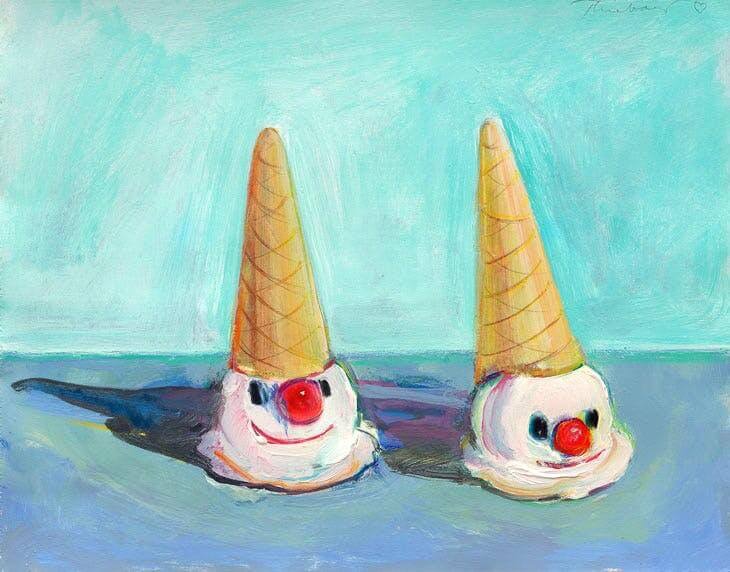
Despite what you might have heard, I’m not a complete dolt when it comes to art. Well . . . okay . . . maybe close. But I did once take an Art Appreciation class in college. It was a “Ten” Course. A fella name Wayne Thiebaud was the professor. He painted gum ball machines, ice cream cones and slices of cake. This appealed to me. I could relate.

Dov’e la gelateria?

A “Ten” course was a survey course for non-majors. So, I’m pretty sure we covered all your High Renaissance masters. Your Michelangelo, da Vinci, Donatello, Raphael, and Bernini. I took the class on a “pass/no pass basis” and nailed the “pass”, so I know I once knew something about these guys.

I know I did.

But if you had asked me a week ago . . . before I began to cram for this trip . . . I wasn’t entirely certain if Bianchi made busts and Bernini made bikes. Maybe it was sewing machines?

Where did that knowledge go? I know it’s been fifty years so I accept that it may take time to find the right box in my addled attic and blow the dust off. I get that. But you’d think once I find the box, and lift the lid, the memories would come floating back.

They don’t. I got nothing. It’s not that I can’t find the box. The damn rats have carted it off.

I’m told I should shake this habit. Learn to “live in the moment”, observe, accept, and free my mind of the angst of losing information and this desperate desire to cram more information back into it. My Peloton spin instructor says to exhale through my nose, drop my shoulders, and drop my “baggage.” Cathy reminds me of the emotional energy I waste each morning dwelling on things I cannot change. 

Apparently, I need to quiet my mind to achieve peace of mind.

I get the idea.  I’m not sure about my Peloton instructor . . . I think she’s a man hater . . . but I know Cathy wants what’s best for me. My problem is I have a narrow nose, have always relied on my mouth to breathe, and serenity . . . like sleep . . . seems something for which there will be plenty of time later.

A data dump now seems premature. Why purge even a small corner of my meager mind when, judging from my deteriorating recall, empty headedness should be complete long before the movers arrive.

My problem is I’m a lifelong cogitator.

I don’t want to clear my mind. I want to fill it to the rafters with useless information. You know . . . the kind of stuff that makes you look bad-ass watching Jeopardy or prompts Cathy to look at me with wonder after I pull a random answer out of my ass during the Sunday Times Crossword.

In my experience, while “now” is a nice place to visit, it’s best not to overstay one’s welcome. Better to slip out of neutral, rev the cognitive engine, and get busy stewing about something. You can’t very well be an old codger if you don’t cogitate, now can you. 

Case in point: Leonardo da Vinci.

I’ve been reading Walter Isaacson’s biography about da Vinci in preparation for this trip. Leo had it bad. He ran around with a “zibaldone” hanging from his belt. It was a sketchbook in which he jotted down his observations, thoughts, “to-do lists”, and questions to ponder. Historians have found 7200 pages, but this is estimated to be only one quarter of what Leo wrote. Imagine . . . 28,800 pages of rumination and cogitation from a mind raging with curiosity.

Not that you and I would understand the missing pages even if we found them. He wrote left-handed, right to left, so as not to smudge the wet ink as you might were your palm to trail the nib of your pen. And just for shits, grins and giggles, he wrote everything in a “reverse” fashion that you and I, even if we could read Italian, could only make out in a mirror.

Think about that. And while you’re doing that, ask yourself, why does a mirror flip an image side to side but not top to bottom? Ever thought about that? I don’t know the answer, but I like to think Leo would be proud of me for asking the question.

Talk about “SQUIRREL!” The man went down more rabbit holes than Beatrix Potter. Everything . . . I mean everything . . . was a shiny object. He didn’t fight off distraction; he slept with it. He once made a note in his trusty zibaldone to remind himself to “describe the tongue of a woodpecker.” Then he did.

Why? Who the hell knows.

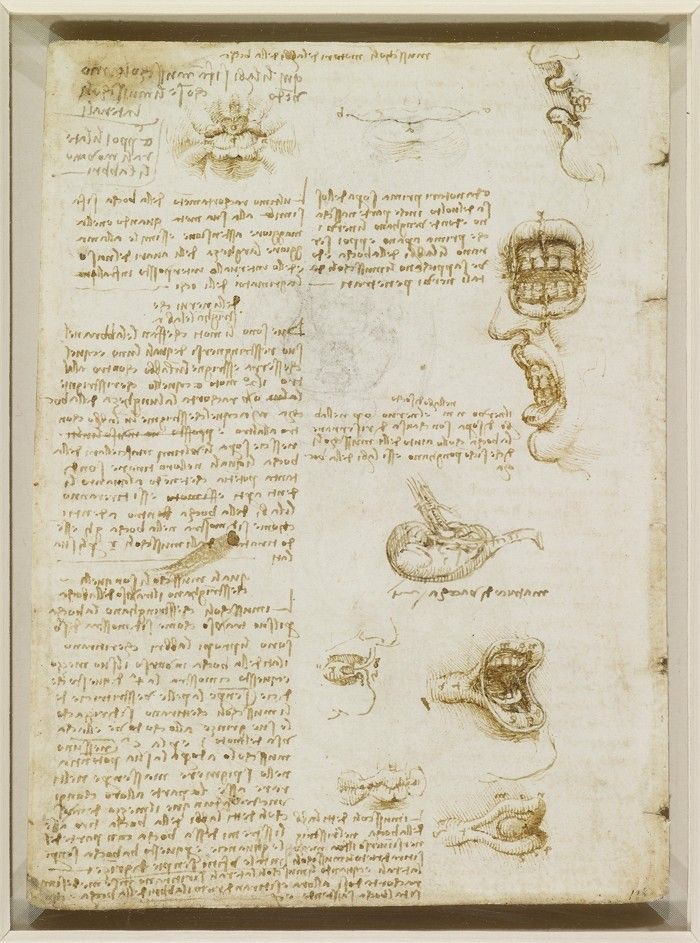
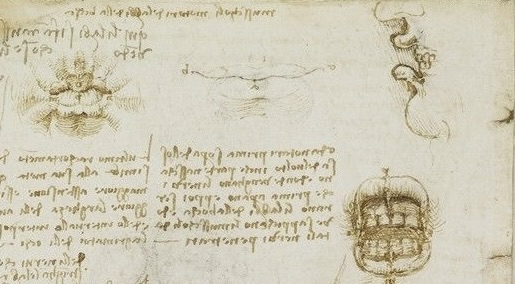
Take this page. It’s my favorite from his zibaldone. Leo was curious about the muscles in the face, particularly how our lips work to produce expression. How is it we can smile or frown or pout?

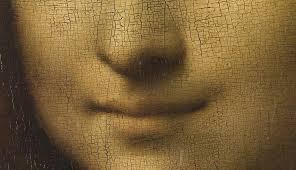
If you look closely at the center of the top of the page you’ll see a squiggly horizontal line . . . a crease . . . and the feint outline of the upper and lower lip beneath it. Recognize that crease?

No?

How about now . . . ?

You see.

I do too. . . now.

I didn’t used to. I’ve “seen” the Mona Lisa in Paris. Several times. Each time, it was mid week in November. I went early, waited at the door until the Louvre opened, and beelined to find her so that we might have a “moment”, just the two of us, with no crowds to get in our way. Each time, I came away saying “yeah . . . I dunno . . . I don’t see what the fuss is about.”

I know . . . I know . . . stupid, huh? But in my defense, I was . . . as John Cleese once put it . . . “too stupid to know how stupid I was.”

I know that now.

The most enigmatic expression in all of Western art came about because da Vinci (1) wondered how lips work, (2) spent hours wondering about the interplay between light and sight, and (3) observed that when you really look at how we look, we see things different with peripheral vision than we do focusing.

Da Vinci knew all that when he set out to paint that smile. He wanted to capture more than the appearance of Lisa Gherardini. He wanted to capture the sometimes endearing, sometimes maddening, always mysterious nature of femininity. Her smile, like her mood, like time itself, changes with the blink of an eye.

Glance at her from the corner of your eye and she appears to be smiling. Stare at her straight on, and she appears indifferent. From whichever angle you look, she looks back bemused at your uncertainty, pleased that she has you guessing.

Kinda like Cathy looked at me last Saturday at the Rincon Valley Little League field when I told her I plan to take only one pair of shoes on the trip. I couldn’t quite tell whether she was saying “grande idea” or “tuo funerale.”

Leo was right.

Time changes in the blink of an eye. The light we see is gone. The things we knew . . . or thought we knew . . . recede beyond recall. I suppose it’s not half as important that we remember the answers as we remember to keep asking the questions and jot them down in our zibaldone.

Postscript

June 6, 2022

We are somewhere above the Rockies. Cathy is asleep beside me. The entire cabin is dark save the glow of my laptop. The only sounds are the muted roar of rushing air and powerful jet engines outside and the tapping of my keypad inside.

         My short-term memory, already short, is growing shorter. I’m sitting here coaxing recollections to cooperate, like a border collie in a sheep dog trial, sensing time is about to run out, herding his charge into a pen.  Damn sheep won’t do what I want.

         It is a cliché, but true: the main attraction on a trip to Ireland are the Irish people.

  • Sean the farmer, seeing us pull up to the cottage at Dunluce and noting Cathy is driving, pulling me aside and whispering, “Do ye not know how to drive an automobile, Robert?”
  • Our first cabbie, after being told we are getting married, with no guests at the wedding, saying “That’s brilliant; feck em all.”
  • The plump woman working in a donut shop where we stopped to tend to Cathy’s low glucose (okay, and maybe get me a pastry), sharing that she had been to America and once went wine tasting in Napa County, recalling “I’ve never been so fecked up in me life; I mean, what’s the point of drinking it if ye can’t swallow.” 
  • The bartender in Portrush, when I ordered a Whiskey Sour, having had a delicious one in Dublin, looking at me as if I had lost my mind and asking, “Now why would ye want to ruin good whiskey by making it sour tasting?”
  • The cabbie taking us back to Dublin, after Cathy and I had a wee testy moment while I tried to navigate us to a gas station to top off the rental car, asking us if we had an automatic transmission and, looking relieved, saying “That’s good; I’ve seen many a married couple fresh from a row at Hertz”;
  • The woman in the United Polaris lounge with whom Cathy became a BFF, an Ecuadorian CEO, just into Dublin from Prague, waiting for her flight to Mexico City, who sported designer glasses that gave her the appearance of a female Ari Onassis, telling Cathy how hard it is to get “her people” to “just stop worrying about everything.”
  • The cabbie instructing us on the proper terminology in Ireland, “Ye don’t say “awesome”; ye say “brilliant.”
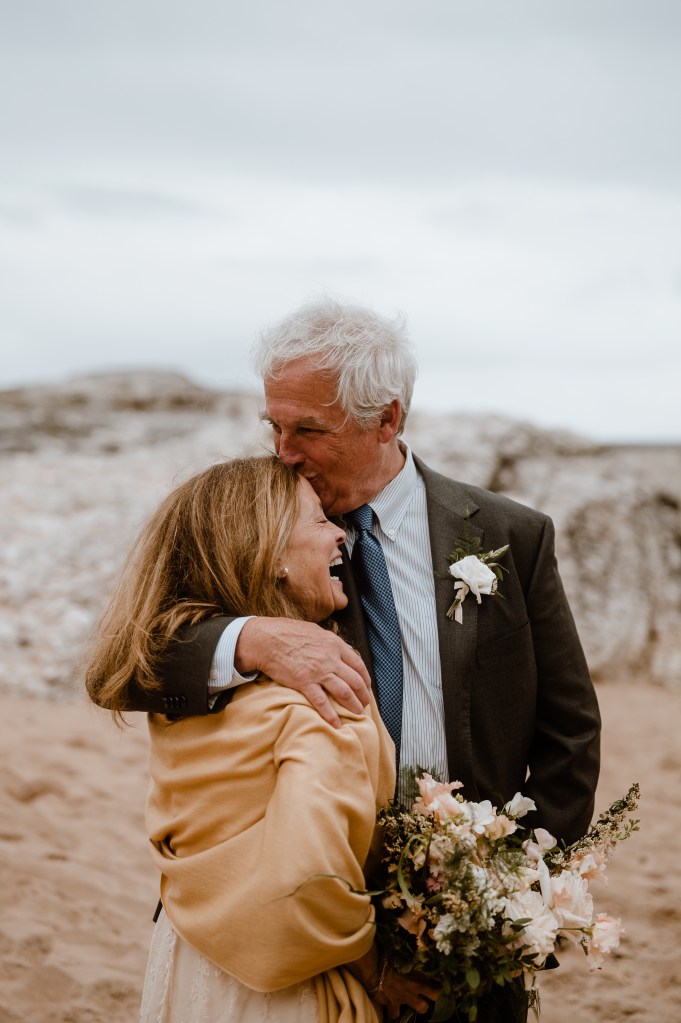
  • Or when our wedding photographer recalling how, just the past week, a husband, despite his bride’s demand, balked at kissing her on the forehead, complimented me on my technique and I told her it was “a signature Jackson move.”

I wish we had more time.  More time to create memories. But the lights have come up and the flight attendant has told me to “stow my tray and return my seat to an upright position.”  I need to wake Cathy and put this laptop to sleep. 

         I’ll find more memories another time. For now, I’m opting for the signature Jackson move.

“Don’t Hurt Your Head”

June 4, 2022

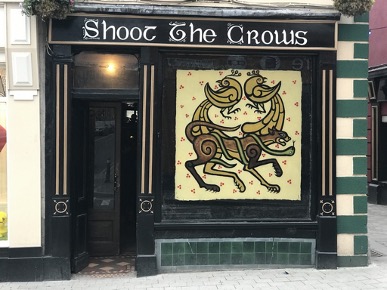
On our first night in Sligo, Cathy and I walk into “Shoot the Crows.” It’s an old, old pub where the proprietor tells us that the bench on which we are sitting and the floor on which we are walking date back over 155 years.

         The pub, now referred to by locals as “Shoots”, got its name when the original owner, an enterprising “publican”, fell upon a clever idea by which to attract customers.  In 1867, crows were considered a pest and the government paid a bounty to shoot them. The trouble was the government only paid once a week, which was far too long for patrons to wait to buy a pint. So, the owner agreed to accept payment in crows in lieu of cash and would turn the dead birds in later.

         It is always a bit intimidating to walk into a local pub. Cathy and I stick out like sore thumbs and when, as here, the pub is populated by only a handful of locals, the temptation is to agree “maybe somewhere else” and hightail it out the front door. 

On this night, as we debate between flight and fight, the early returns favoring flight, the man behind the bar, asks “what will ya have.” Cathy mumbles, “hmmm, let me think.” The barkeep, not knowing that her “Big D” prevents her from having a pint, says over his shoulder, drying a glass with his towel, “Not a problem, but don’t hurt your head.” When I laugh as this, Cathy shoots me a look as if to say, “it’ll be more than your head hurtin, buddy.”

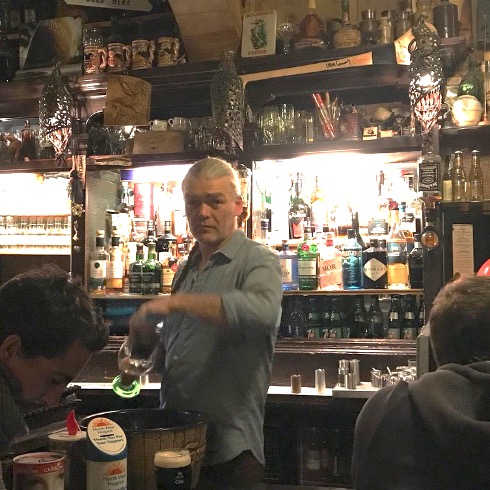
Our anxiety is not helped by the look of the proprietor. His name is Ronan Uisce Watters. He is a man with a big barrel chest, a short waist, bushy Bernard Shaw eyebrows—probably a former hurler or footballer–with gray, blonde hair pulled back tight and extending in a long pony tail, sometimes down his back, sometimes over his shoulder. Think Nicholas Cage in “Con Air” with an Irish brogue and you’ll get the idea.

He quicky reels in his joke, sensing it might night have had the desired relaxing effect, smiles and says to the three fellas sitting at the bar, “the tradition here is to buy a pint for everyone at the bar.”  When I reach for my Visa, he says “I’m only kidding.” The other fellas protest, saying, “We’re not.” 

Searching for what to say, I share that we are learning about whiskey. Cathy asks does he have any Midleton’s. Ronan confides that Midlton Rare is far too expensive to open for the likes of the fellas at the bar and the only bottles he keeps . . . and there are many he has bought over the years . . . are the bottles he has locked up at home, an investment for his daughter’s college education.

You see Middleton Very Rare is a thing of legend in Ireland. The distillery in the small town of Midleton, outside of Cork, was founded in 1984 by Barry Crockett, who was born in the distiller’s cottage at Jameson and grew up the son of a master distiller. Crockett set out to make the finest Irish Whiskey ever.

         Since 1984 he bottles just 2500 bottles a year of Midleton Very Rare or “VR”. Today, if one looks and is prepared to part with a good bit of coin, one can find Midleton VR, Midleton Barry Crokett Legacy, or Midleton VR  Ghaelach Grinsell Wood. The latter is even more rare because it was casked in wood harvested from nine 130-year-old Irish oak trees, now almost impossible to find. (At the duty-free shop at Dublin Airport, a bottle of VR goes for 250 euros or $268.)

         I ask Ronan, “Okay, if not Midleton, what would you recommend?” This he takes as a challenge and gives us a once over like the carny at the county fair that used to guess your weight. After a bit, pointing to me, he says, “For you, 15-year-old Red Spot” and, studying Cathy, he says, “And for you, 16-year-old Black Bushmills.

Cathy and I find a “snug” in the front of the pub. Old pubs in Ireland have small screened off rooms attached to the bar. They are called “snugs.” Prior to the 1960s, pubs were the exclusive domain of men. Women were admitted only to the “snug.” Now they serve as cozy private stalls to chat with a friend or sweetheart.

We sip our whiskeys, exchange them, sip again, and agree Ronan called it right. I prefer the Red Spot to the Bushmills; Cathy prefers the Bushmills to the Red Spot. Ronan joins us in the snug, explaining the history of the pub and the traded commodity that fine whiskeys have become for investment purposes.

We pass an hour in the pub, shout to Ronan, “thanks for the education” to Ronan, and leave. We walk the quiet cobblestone streets of Sligo back to our hotel.

On our second night, we set off in search of music and hear, from outside the doors of McHugh’s, a solo guitar player wailing away. We step in. The young man, probably American, is excellent, pounding out solo riffs and belting lyrics to classics with a gravelly voice somewhere between Bruce Springsteen, Joe Cocker and Bruce Hornsby.

The place is humming. We climb the stair, intending to find a corner where we can hear each other above the music. We sit in a corner directly above the musician, making up back stories as we watch the stream of mostly young people wander in. Fashions for young Irish women now are not, in our opinions, flattering. Short, cropped tops with what seem like sweatpants pulled up so high in a stretched wedgy that little is left to the imagination.

 The boys have haircuts, shaven close on the side, long on the top, with a whisp on the top extra-long to fall in their faces. It’s a look somewhere between Opie and the Hitler youth corp.

 Watching the girls snatch glances of the boys while the boys, seemingly oblivious to the girls, shout and boast to one another, confirms that the universal rule that women mature faster than men is as true on the west coast of Ireland as it is on the west coast of California.

We each have two Bushmills. I’ve never been drunk in my life, but weaving my way back to the corner, a whiskey in each hand, my glide pattern to landing is not what one might call a straight line. Yawing a bit, my approach, while not sideways, is not entirely parallel to the runway. Cathy looks concerned.  

 I suppose all drunks feel this way, but I am particularly funny tonight. I’ve got Cathy laughing to the “I can’t breathe” threshold and am feeling pretty good about myself. 

 Thankfully, Cathy does not have to drive, and I do not have to navigate. We call it quits at two and point ourselves toward the River, her hand clutching my arm, my hands tucked into my pockets, and make our way back to the hotel.

 Our trip is nearing the end. Tomorrow, it’s back to Dublin and then home.

Shirtsleeves in Sligo

June 3, 2022

Weather wise, we’ve led a charmed life. 

We’ve had to don our raincoats only once during our entire time in Ireland. When it has rained, we’ve been in the car traveling between destinations.  Today is no exception. We planned for a day in Sligo just to walk about. It was raining as we drove here. It will rain tomorrow when we leave for Dublin. 

But today, it is shirtsleeve weather. Downright hot.

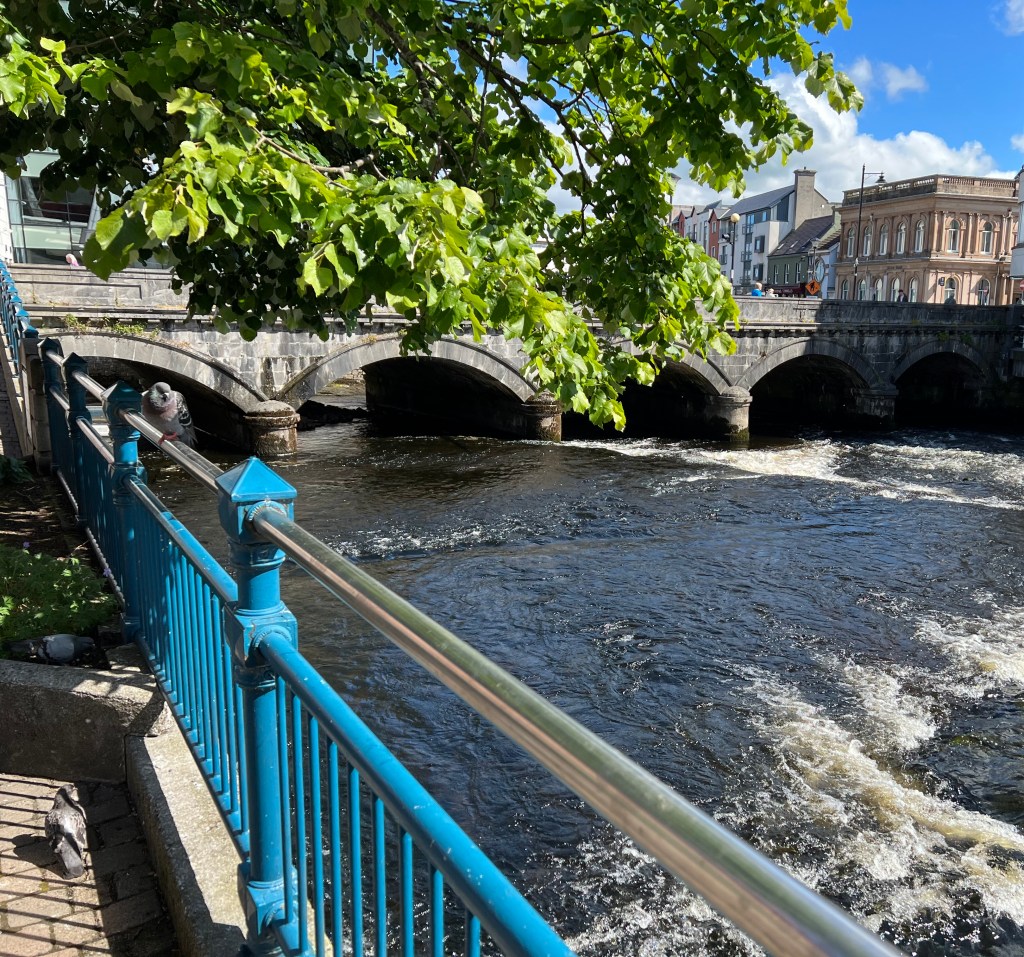
Cathy has very fond memories of Sligo, as this was the hub of her family’s trip back in 2006. When she, her folks, Nick, Lisa, and cousins were here last, it was raining cats and dogs. She marvels how different a walk along the river is in sunshine.

Sadly, things other than the weather have changed as well. Covid seems to have taken its toll on Sligo. The bookstores which she and Lisa so loved are gone; only one remains. The Yeats Society still exists . . . a kind woman in a small office on the second floor, is helpful . . . but the museum the Society once operated is gone. Many streets are undergoing work, so the sounds of construction and the smell of slurry seal assault the senses.

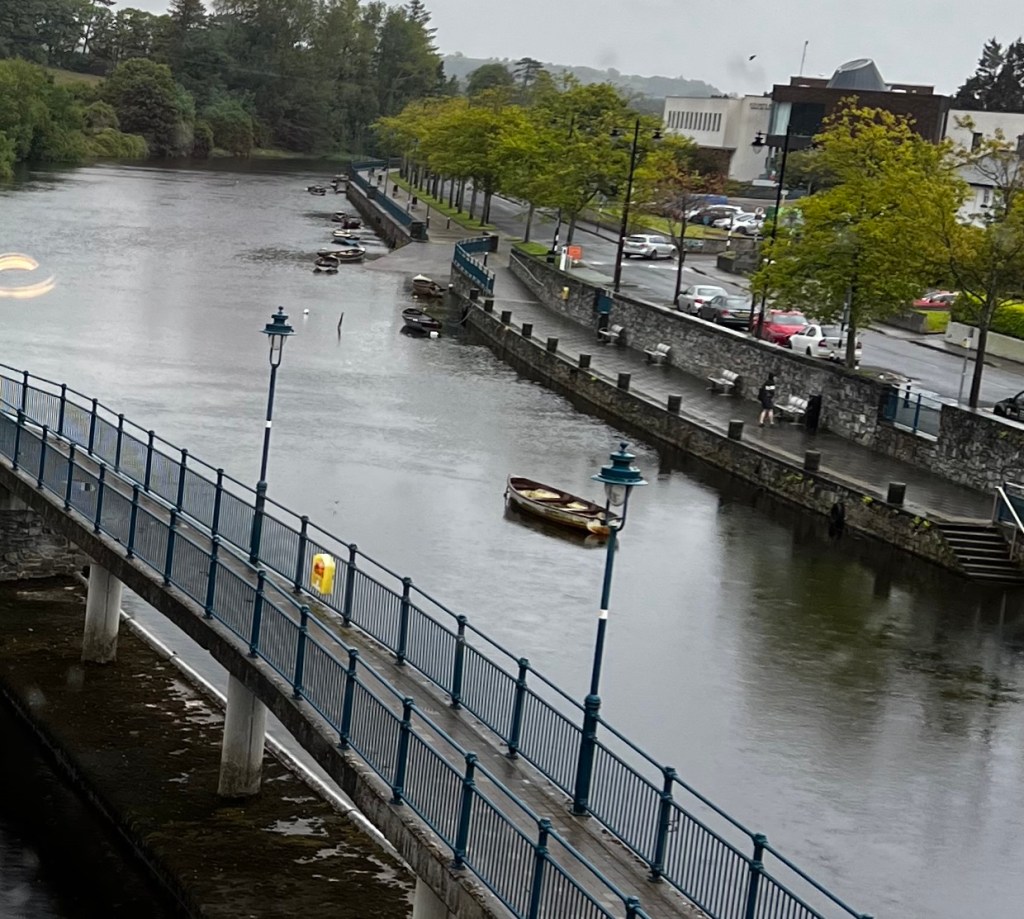
We are staying in the Riverside Hotel. It sits cantilevered over the River and our room at the corner is the best room in the hotel. We look down upon the water where  swans float between mallards.  This is our view the rainy day we arrived.

We start our day, as always, tea and coffee. We learn from a young busboy in the hotel restaurant, who hails from there, that Donegal is not pronounced “DON—ee—gall” with the accent on the first syllable, as I have pronounced it, but “don—ee—GALL”, accent on the final syllable.  It’s as if syllable were not pronounced “SIIL-uh—bull”, but “sill—uhh—BELL. Cathy teases me as I dwell on this from time to time throughout the day. 

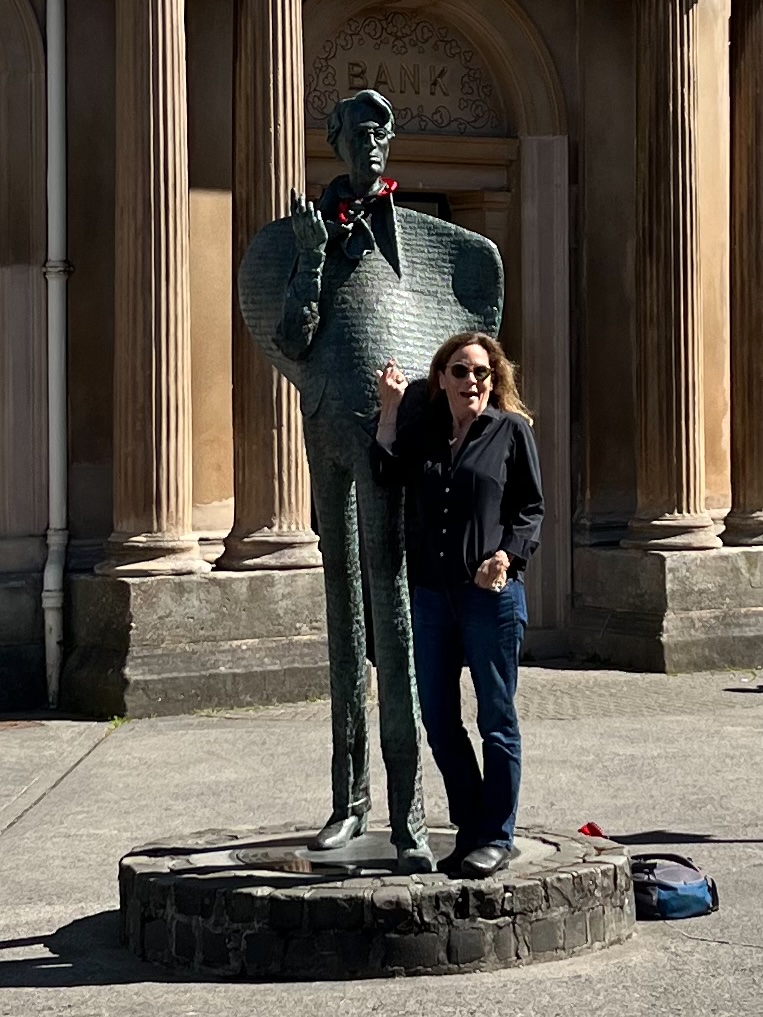
We make our way to the statue of Yeats which Cathy dearly loves. She had hoped to find a miniature of the bronze. It strikes her fancy. But the kind woman in the Yeats Society office tells us the artist never consented to commercialize his work and destroyed the cast after it was completed.

We make our way to Foley’s liquor store to take a photo where Cathy once photographed Nick to share with her friends Ned and Sally Foley.


Newfound students of whiskey, we stop in the bookstore where I of course cannot leave empty handed. One treasure, a guide to Irish whiskey, I plan to study on the plane ride home. I plan to make this photo a jigsaw puzzle.

Our blood sugars decide to do the Texas-two-step. Cathy’s climbs to over 350 and we race back to the hotel to tend to it. Mine—which we test with Cathy’s dad’s old finger prick device—dives to 70. Cathy gets an insulin shot; I get a pastry by the river.

         There is no justice.

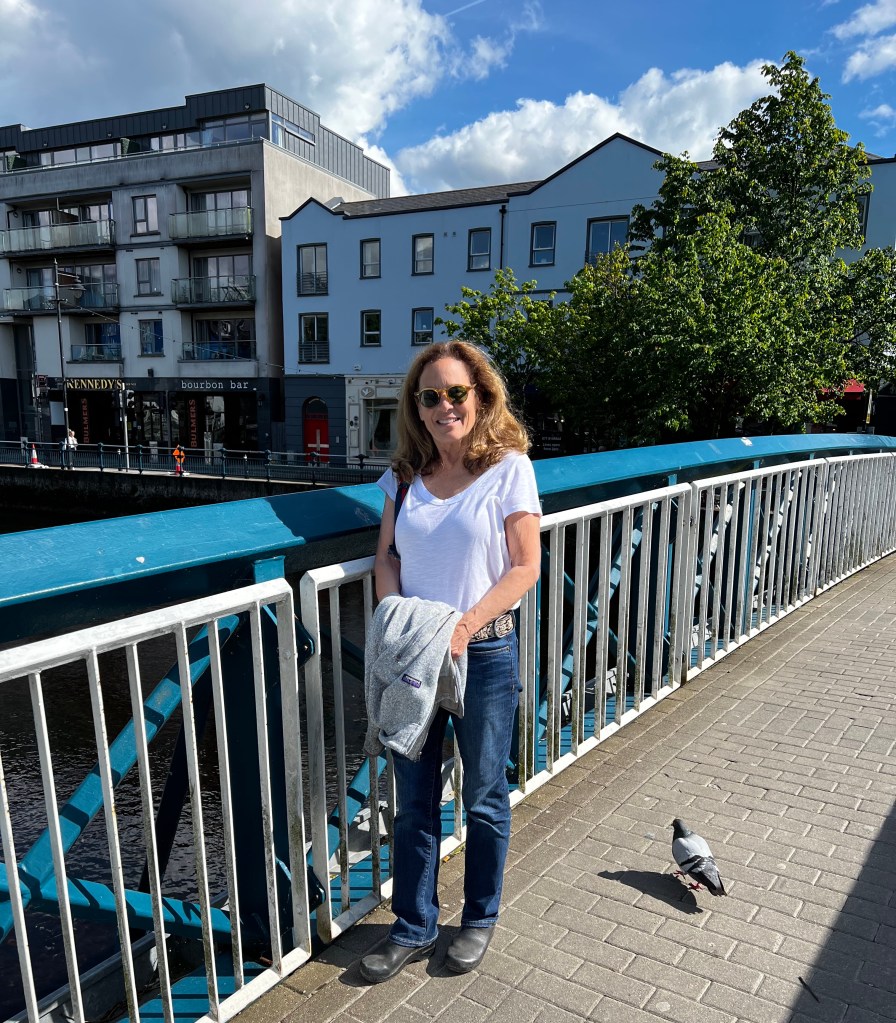
Sligo is all Cathy remembers. And it isn’t.  Times change.  Bookstores come and go. Our memories, like Yeats’ green grass, must yield to time and the mountain hare.

Memory

One had a lovely face,

And two or three had charm,

But charm and face were in vain

Because the mountain grass

Cannot but keep the form

Where the mountain hare has lain.

“Their Toddler Wobbles Gone”

June 2, 2022

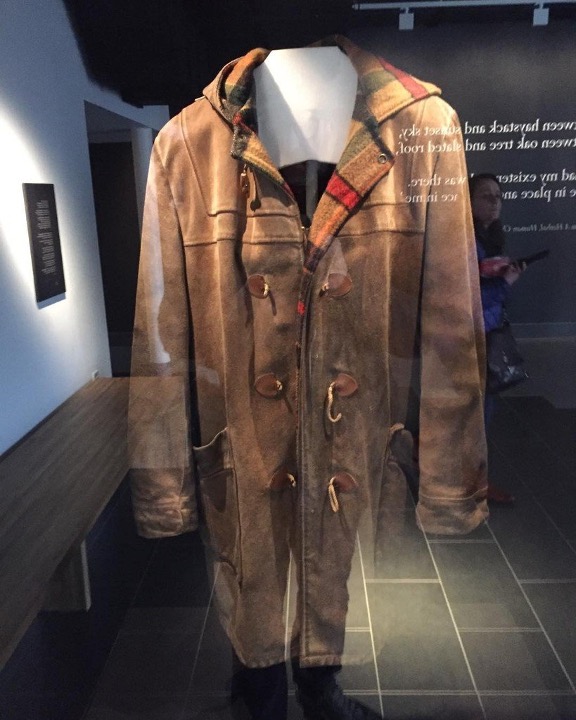
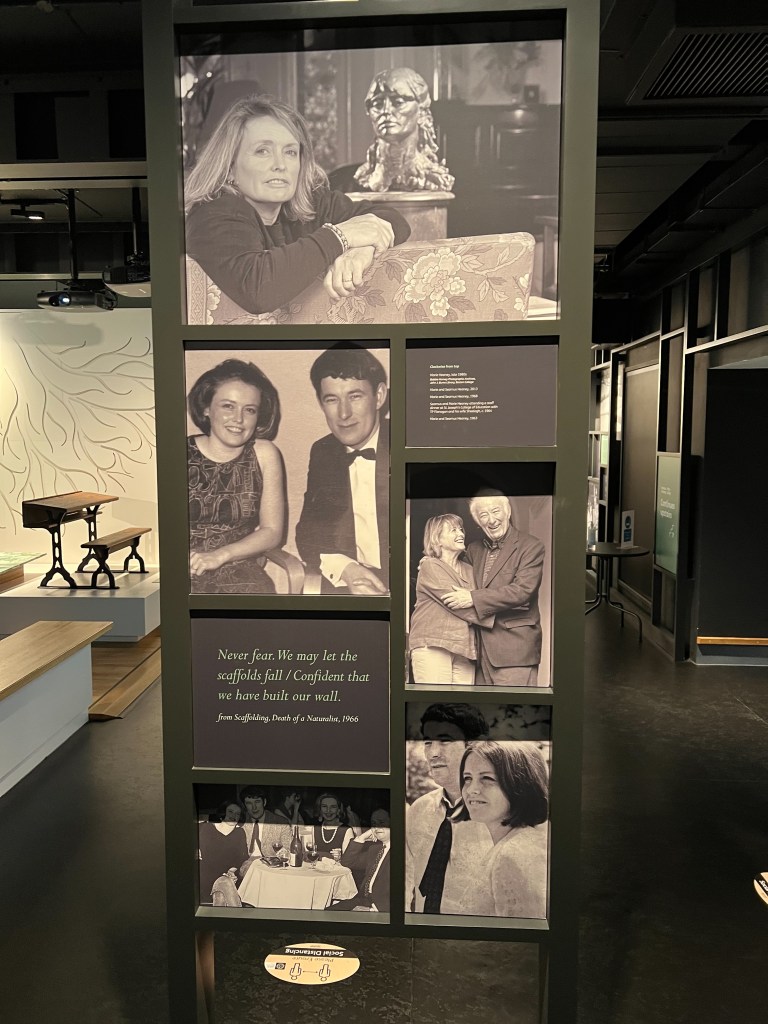
Seamus Heaney wore this coat. Most every day. It fit him.

Seamus Heaney, with whom I am only beginning to become familiar, was a Nobel Prize winning poet who grew up in Ulster just a few minutes down the road from Ardtara. He died in 2013 at the age of 73 and is the most celebrated modern writer, and perhaps the most revered man in all of Ireland.

         A beautiful museum lies in Bellaghy, a small village northeast of Lough Beg, which chronicles his life and work and is perhaps, for a student of words, hallow ground. Exhibits show his family, and with each photograph, one can listen to him read from his own work. If you have a chance, Google a Charlie Rose interview with Heaney; it is important to hear his voice. 

When Heaney was a boy, it was the custom that a boy follow in his “da’s” work. Heaney’s father, Patrick Heaney, worked in the fields and traded in cattle. His mother was Margaret Heaney. The two so loved their son, and knowing that his love and gift was writing, scrimped and saved to send him to St. Columb’s College in Derry. 

As he left, they gifted him a Conway Stewart pen, a fine—very expensive—writing instrument. He would write poetry with it his entire life.

Perhaps Heaney is so loved by the Irish people because he so loved his own family. He wrote of them often. 

Of His Aunt Mary

the reddening stove                           

sent its plaque of heat

against her where she stood

in a floury apron

by the window                             

Of His Father

I stumbled in his hobnailed wake,

Fell sometimes on the polished sod,

Sometimes he rode me on his back

Dipping and rising to his plod.

I wanted to grow up and plough,

To close one eye, stiffen my arm

All I ever did was follow

In his broad shadow around the farm.

I was a nuisance, tripping, falling

Yapping always

But today it is my father who keeps stumbling

Behind me, and will not go away.

Of His Mother

When all the others were away at Mass. 

I was hers as we peeled potatoes.

They broke the silence, let fall one by one

Like solder weeping off the soldering iron:

Cold comforts set between us, things to share

Gleaming in a bucket of water

And again let fall. Little pleasant splashes

From each other’s work would bring us to our

Senses.

So while the parish priest at her bedside

Went hammer and tongs at the prayers for the dying

And some were responding and some crying

I remember her head bent toward my head,

Her breath in mine, our fluent dipping knives—

Never closer the whole rest of our lives.

Of His Wife Mary

Masons, when they start upon a building

Are careful to test out the scaffolding;

Make sure that planks won’t slip at busy points

Secure all ladders, tighten bolted joints.

And yet all this comes down when the job is done,

Showing off walls of sure and solid stone

So, if my dear, there sometimes seem to be

Old bridges breaking between you and me, 

Never fear. We may let the scaffolds fall,

Confident that we have built our wall.

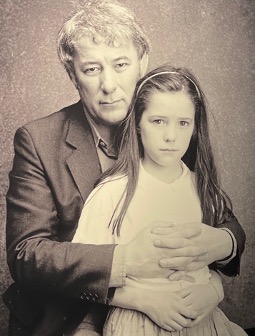
Of His Daughter

Aren’t poems like your toys, Daddy?

Catherine said.

And didn’t you and mommy make me

And God made the thread?

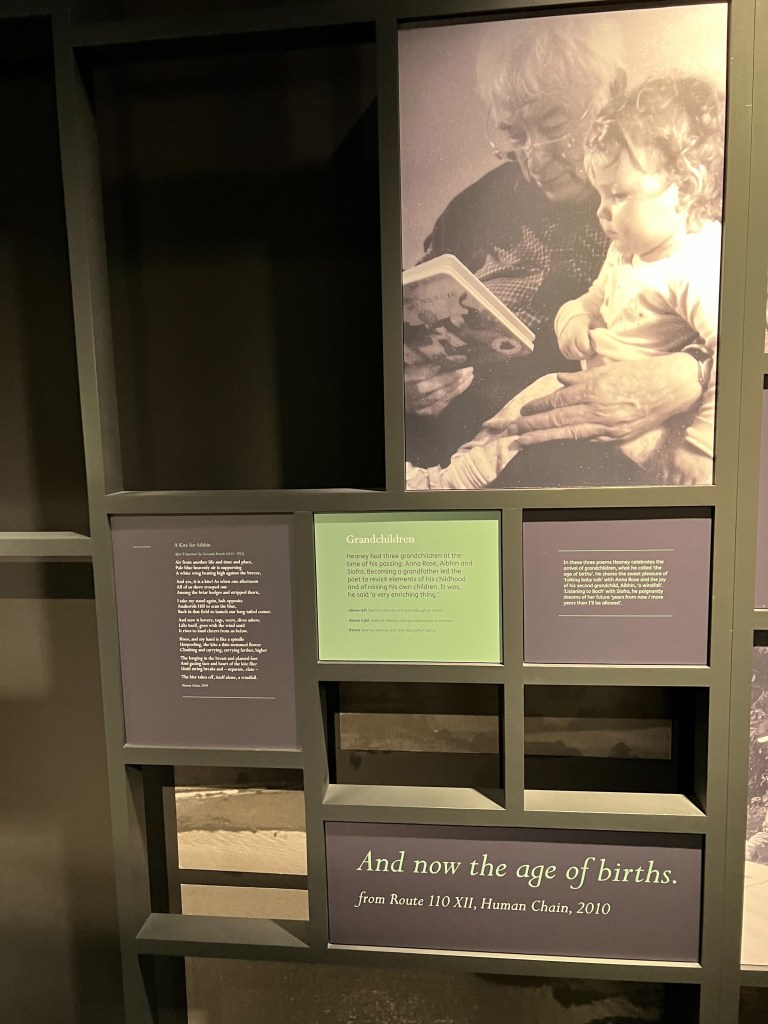
But it was his love of his grandchildren that I think most resonates with Cathy and me as we walk this museum. Referring to this time in life —when too often we see and fear death—he wrote, “And now the age of births.” 

Of his granddaughter Siofra, he wrote this

Energy, balance, outbreak

Listening to Bach

I saw you years from now

(More years than I’ll be allowed)

Your toddler wobbles gone

A sure and grown woman.

Your bare foot on the floor

Keeps me in step, the power

I first felt come up through

Our cement floor long ago

Palps your sole and heel

And earths you here for real.

An oratorio

Would be just the thing for you:

Energy, balance, outbreak

At play for their own sake.

But for now we foot it lightly

In time, and silently.

Just moments before he died, Seamus Heaney–son of Patrick and Margaret Heaney, “Da” to Michael, Christopher and Catherine, “Daddo” to Aibhin and Siofra—sent a text message to his wife Marie, in his beloved Latin. It read, “Noli timere”— “Don’t be afraid.

This trip has been about family. It’s about Gram. The Rooneys. The Jacksons. 

But our family tree is so much more than those two branches. It’s about the Perrys, the Lears, the Beckers, the Bachmans, the Casebiers, the Wallaces, the Sparkes. The best thing about a family tree is that it is a tree. And a tree grows.  It keeps growing and branching, growing and branching, rooted in the past, stretching toward the future.

We know . . .  what Seamus Heaney knew . . . what drove his pen to write . . .  It’s what Mimi said to me not long ago as we watched Craig and Patti play ping pong. I asked her “What’s the one thing your mom taught you that you would want to pass on?” I was fishing for something trivial, maybe a recipe, or a bit of family lore. Mimi was having none of that. Without missing a beat, she said,

“Family is everything.” 

In this world turned on end, the only thing that matters is family. All else is a distraction.

Coco and Daddo are coming home. We’ve got a few more stops before we do. A few more sights to see. A few more Irishmen to meet. A bridge to cross. Some whiskey to drink. But, we’re coming home.

We’ve still got a family to raise. 

The Wild Irish Coast

June 3, 2022

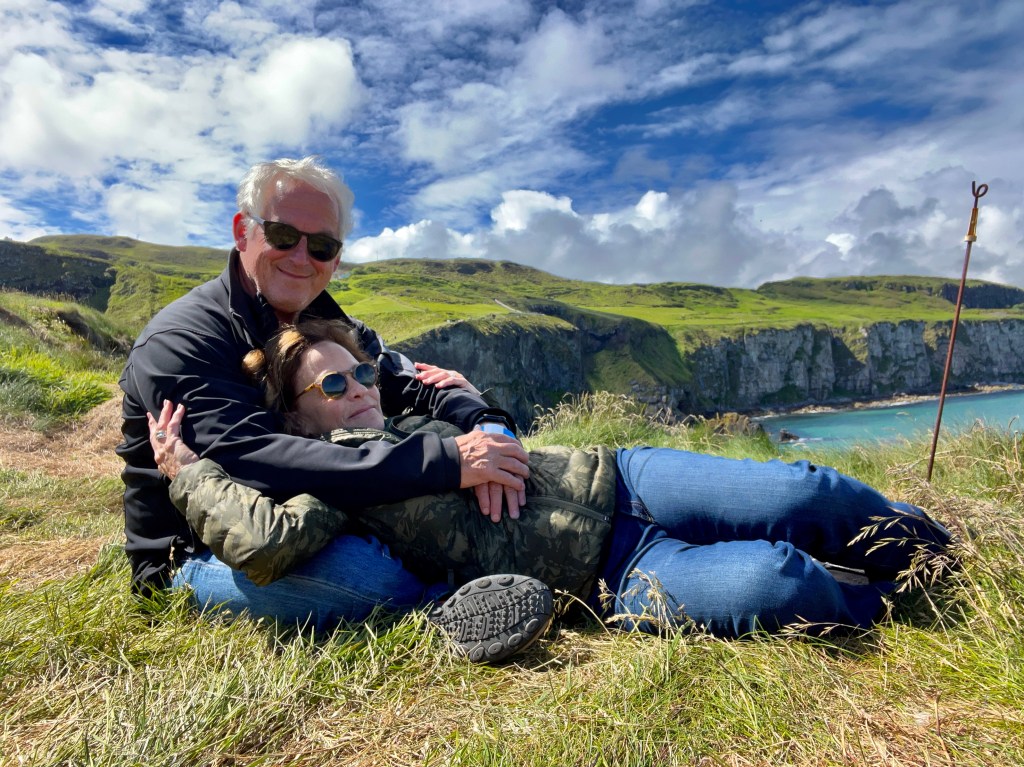
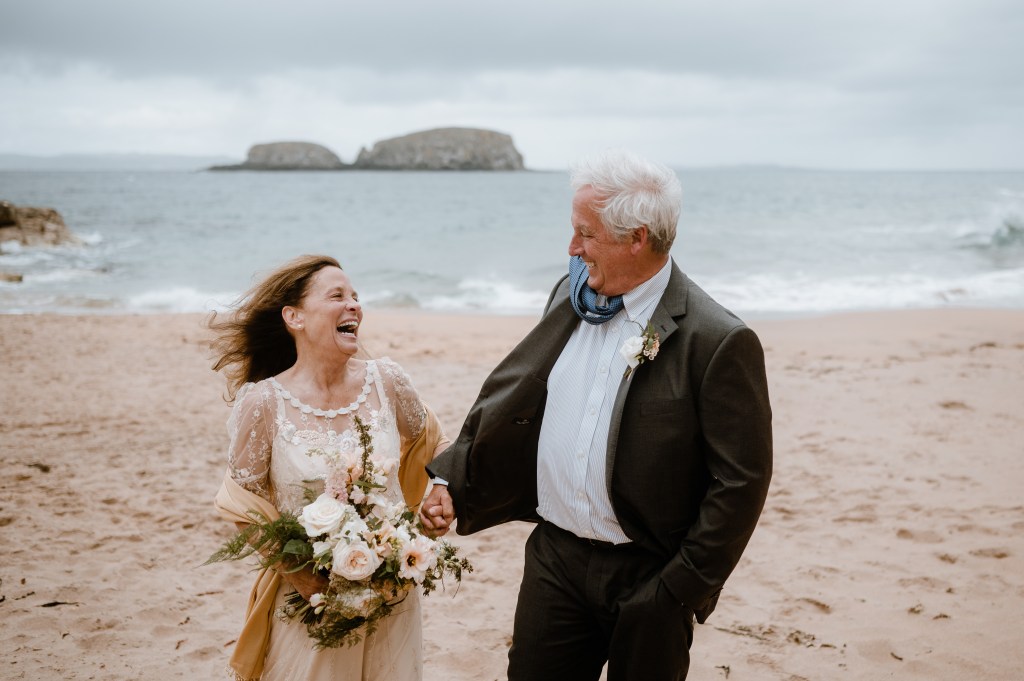
This woman is my wife. (I like to say that.)

She doesn’t like this picture. I do. She doesn’t like it because her hair is wild and in her face and she looks just a tad bit crazy. I like it because . . . well . . . her hair is wild and in her face and she looks just a tad bit crazy.

As a photojournalist, I’m all about truth.

We got married yesterday so, technically, this is our honeymoon. I’ve learned on our honeymoon—just twenty-four hours– a great deal about this woman. 

First, she is crazy.

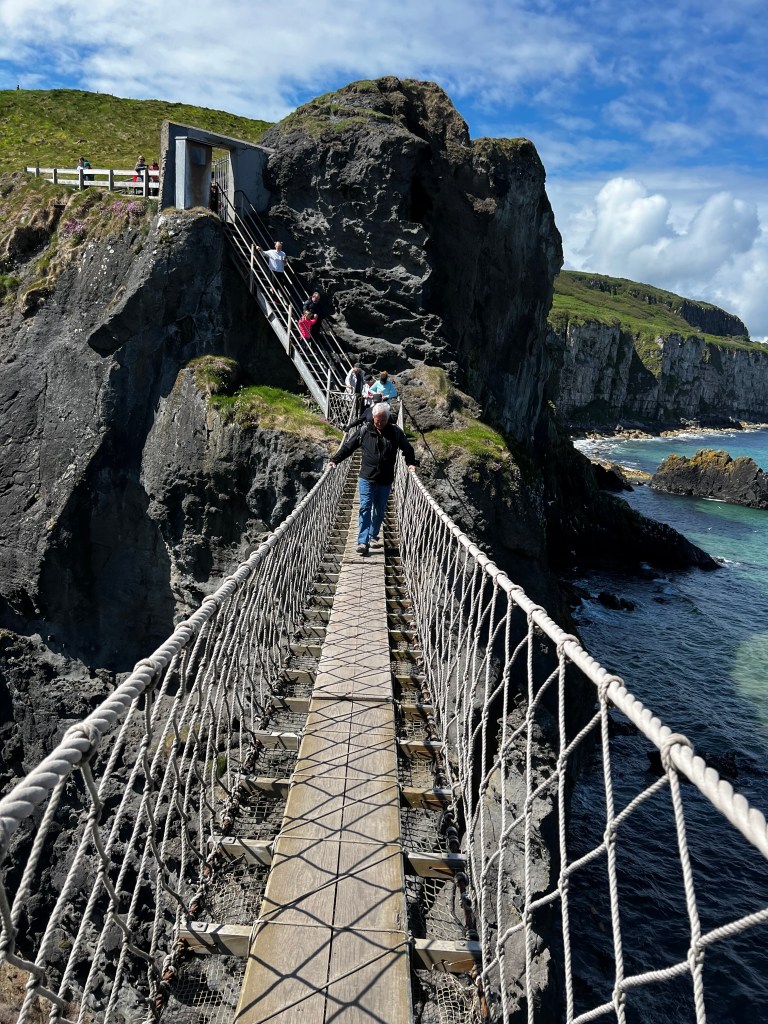
Take for example the Carrick-a-Rede Rope Bridge on the Antrim Coast. Some drunken Irish salmon fishermen back in the 18th century decided it would be a good idea to string a hundred feet above the ocean a couple of boards about as wide as the space separating the salami from the brie on a cheese board.

That’s the bridge and, if you look close, that’s my wife. The one waving.

She floated over the damn thing like Olga Korbut doing an arabesque on a balance beam. 

         This is in stark contrast to her husband. That would be me with his eyes glued on the charcuterie board and his hands wrapped tight around each rope. When my wife suggested I pause mid span and turn around for a photo, I politely but firmly suggested “that’s not going to happen.”

         I’m normally not afraid of heights. After all, I’ve looked over the edge of Half Dome. But, as I got midspan, the shakes set in like the needle on a Richter scale on speed. (Several small children trapped behind me were terrified and their parents apparently did not believe me when I tried to explain I have a disability) 

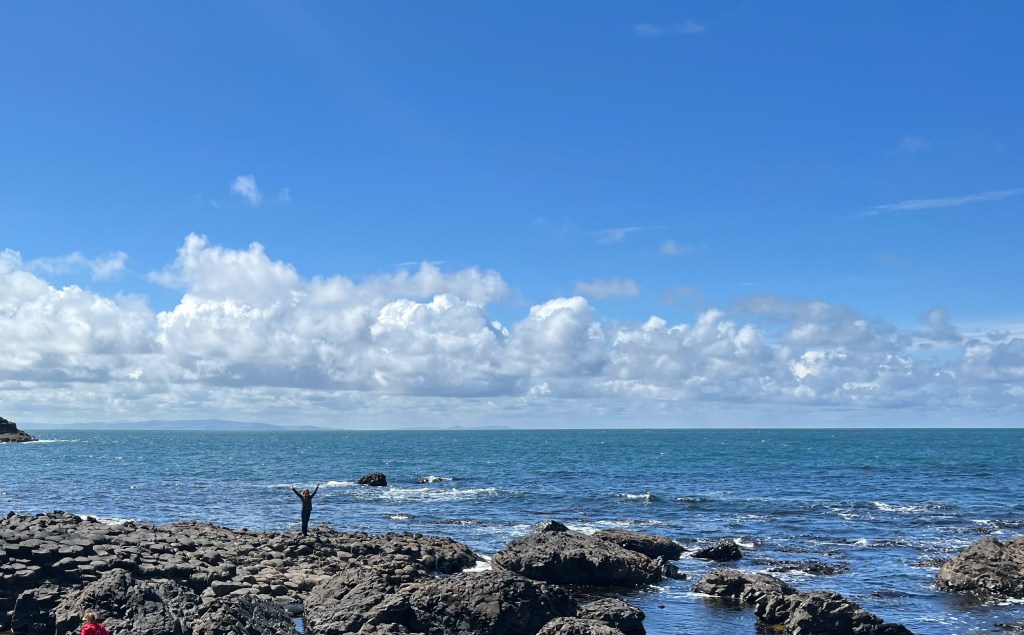
This study in agility and balance was also evident at the Giant’s Causeway. My wife hopped from basalt column to basalt column recalling her boulder hopping days with her brother Bob. That’s her out by the water.

Me? I gingerly made my way. . . oh, I don’t know . . . maybe 10’, might have been 20’ out onto the columns and sat down pretending to tie the knot on my slip-on shoes.  This is me. My wife kindly took the photo from ten feet below to give the illusion that I was resting before making the final pitch to summit Everest.

We make a great team, my wife and I. Yes, she has the looks, the brains, but don’t forget I’m the one who can set up a tripod to snap a photo. That kind of mad skill set is rare.

An Irish Blessing

June 1, 2022

French Toast

For three days I have had French toast for breakfast. It is the most delicious French toast I have ever tasted. Here, at Ardtara in County Antrim in Northern Ireland, they have opted to call it what the French call it, “pain perdu.” That means “lost bread” as the French came up with the idea to make use of yesterday’s stale baguette. 

Maybe it tastes so good because it is. Maybe because of the name. Maybe because, as I sit here feverishly jotting down recollections of yesterday, I just might possibly be the happiest I have ever been. 

I’ll admit that might color my judgment, but it is good French toast. 

Seems to me that each of us is allotted so many days in our lifetime. Some good; some bad. Some pivotal, some routine. Some memorable; some we’d just as soon forget.

For those of us who have lived a good many days, we have the luxury of hindsight and perspective. If we are so inclined, we can reflect on and judge which days in our lives were our best.  Some, such as the births of our children, come readily to mind. Some stand out because of an event or an accomplishment. 

I suspect that many of the best days of our lives pass unnoticed, mistaken as routine, when in fact it was those days where we were at our best or the happiest. Halcyon days are awarded that distinction too late and only if sufficient time has passed by which to draw a comparison.

For many, the “best day of our lives” comes early. My guess is that most folks would point to a day in their youth, a carefree time before the weight of responsibility took its toll. It is, I think, rare that what might be the best day of our life occurs in the twilight of our years when our days grow shorter.

On Sunday, May 29, 2022, just shy of my 66th birthday, on the north coast of Ireland, I awoke to just such a day. A new day. A perfect day. 

It all started with the French toast.

Nine O’Clock: The Staff

We sit down to breakfast. Cathy her coffee, me my tea. The milk and sugar are a blue willow pattern, much the same as Cathy’s Gram’s.  We take this as a sign.

I ask our waitress, Elena, to take our picture. She is almost giddy with excitement. News has spread quickly through the small staff at Ardtara of the older American couple eloping. 

The manager Sean, a wiry fastidious man with a wry smile and a mischievous laugh . . the kind of man who will, after you’ve asked for an iron and an ironing board, pinch your forearm and whisper in a conspiratorial way “no problem, no problem d’at all” as if he were agreeing to place a bet with a bookie . . . has gone into the garden to cut flowers himself, unsatisfied that the florist who provided a bouquet upon our arrival had done an adequate job.  He assures us, with a wink and a nod, he will put a bottle of champagne on ice for when we “come home” tonight. 

Nicola, the middle-aged woman pushing the vacuum over the old rug in the entry of the old manor house, quickly turns it off and, beaming, steps aside to let us pass, as if we were movie stars or royalty. 

A young woman, sitting alone at a long banquet table, struggling to contain her squirming toddler who is crawling from her shoulders to atop her head as if she were a jungle gym, strikes up a conversation. She is waiting for the rest of her family to join her. He presses his face to hers; I comment that he gives new meaning to “Facetime”. 

She apologizes for her son’s shyness when Cathy reaches out to greet him and he recoils. She shares that he loves chocolate and has somehow been convinced that it can be found beneath tables. I tell him this is true, that that is where I often look. His mom laughs, but good naturedly furrows her brow just a bit to suggest I am not helping her efforts to corral him. 

When we tell her of the day’s plans, she is thrilled and says, “Oh, that’s lovely.” This is a reaction we get everywhere we go. People seem to take it as a sign that life might return to normal, and happiness might still be found.

Ten O’Clock: The Walk

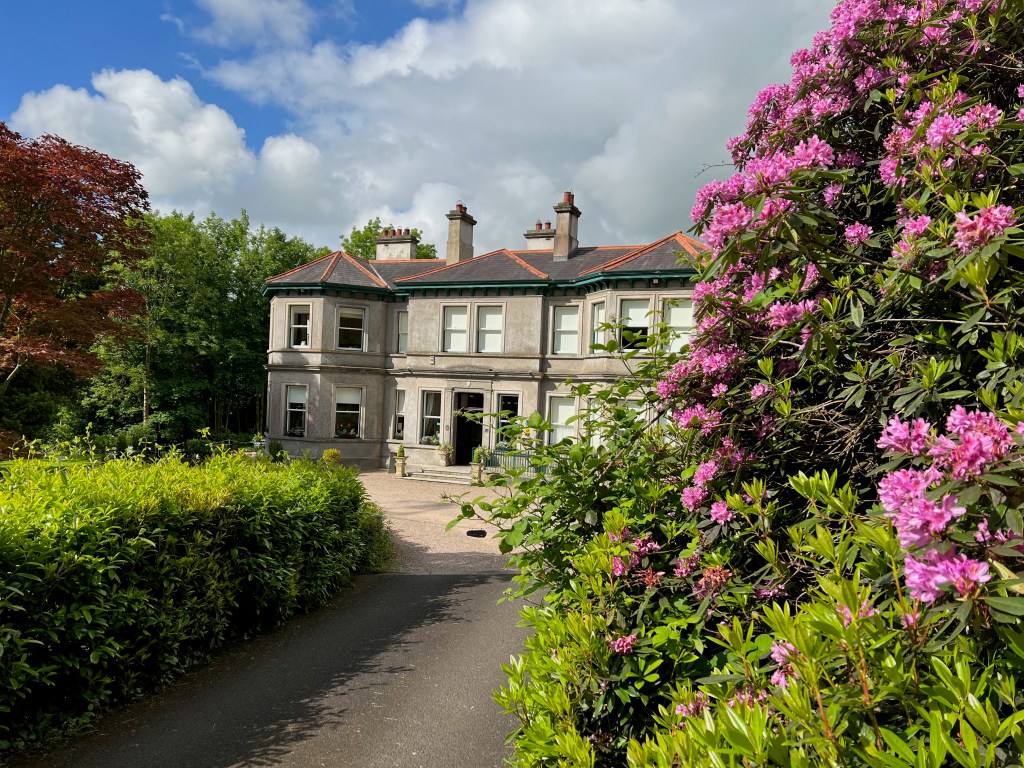
Ardtara is the old home of Henry Jackson Clark, his wife Alice, their four sons and two daughters. It was built in 1896 for “Old Harry” and his family to escape the thunderous noise of the Beetling machines in the linen mills the family owned in Upperlands. 

         The grounds consist of expansive lawns, a path that meanders around the perimeter of the property where, with each bend on the trail, you discover a statue or a gazebo or a small bridge leading to an island in a pond. Sean points out that two redwood trees were shipped from California in 1907 at the price of a king’s ransom.

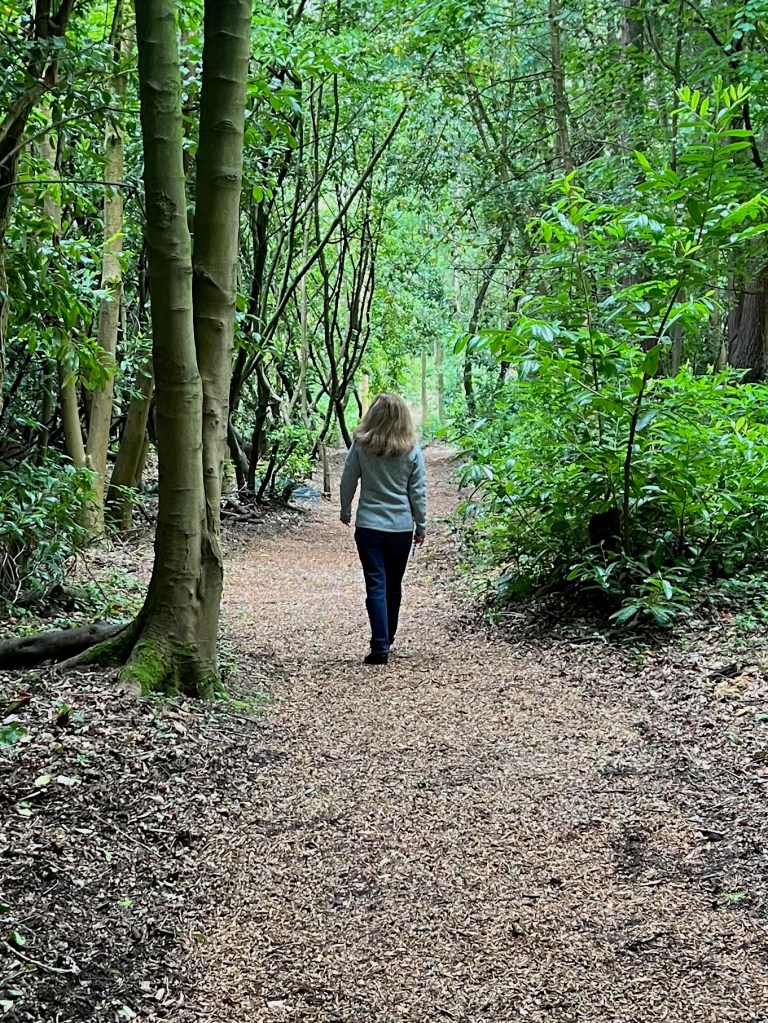
Cathy and I set out to stretch our legs. The path floor is made of wood mulch compressed over time and feels remarkably the same as the pedestrian conveyor walks in the airport in Dublin.

Half Past Ten: The Dress

We return to our room, and I sneak a glimpse of Cathy’s dress hanging on the door. Before I shuffle off to the parlor for a cup of tea, catch up on my writing, and allow her to “beautify”, I tease her that the flowers from Tracy at Willow and Twine will complement the color of her dress, “at least as I imagine it.”

         With that, I am banished to the parlor. Sean, Elena and Nicola take turns looking in on me, asking if there is anything they might get, perhaps “a wee more tea”, and later suggesting “shouldn’t ye be getting ready yourself?” I reassure them we are on schedule, and it won’t take long.

Unbeknownst to me, poor Cathy, without a bridesmaid or her mum to help her, without so much as a magnifying mirror to help her see and relying on a hair dryer that seems powered by the same stream than must have kept the Clark family’s linen mill running, manages entirely on her own to get ready. 

When I return to our room, I am given two tasks. The first is to button up the last of many buttons on the back of her dress. I nail it. The second is to unfasten the tiny clasp on her Diabetic Medic-Alert bracelet. After I struggle for five minutes, fumbling with shaky fingers, we agree—but later forget– to try again before the ceremony. Cathy will wear it when we exchange vows.

Did I mention the dress? No? Well . . . That lies beyond my poor words to describe. Imagine something so beautiful–settling like a sigh on soft shoulders, silk the color of linen beneath Irish lace, embroidered flowers trailing to the ground—a dress so beautiful that it can only have been made by the faeries.

Half Past Two: The Roundabouts

Our officiant Sam Hannah, a shy and soft-spoken man with white hair and dark glasses, explained to us when we first met, that the roundabouts in Coleraine are particularly treacherous. This has Cathy on edge.  We allow for extra time to drive north to the Antrim Coast.

I have driven . . . oh . . . I don’t know . . . maybe fifty yards on this trip. That is when I bring the car up from the car park to the manor house. That journey is not going well. First, I struggle for minutes trying to work the electronic seat controls of the damn Mercedes, only to discover the means by which to move the seat up or back is an old school mechanical spring-loaded adjustment lever hidden well below the seat. As minutes pass and Cathy waits above, I grow more and more nervous.

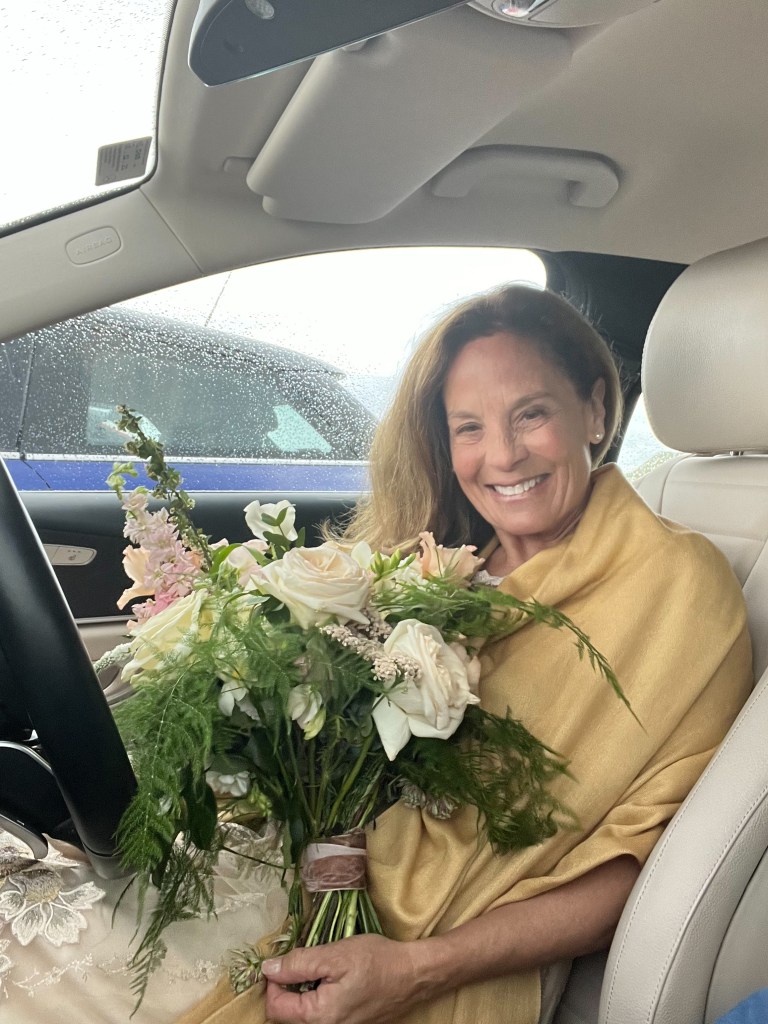
Finally, I climb in with my knees up to my chin, race up the driveway, run in, follow Cathy out to the car, a bouquet in one hand, our day packs in the other. We plop into our seats. Cathy pushes the button to start the engine.

Nothing happens. We look at each other. She tries again. Nothing happens.

Panic is well underway when it dawns on me that I must have left the high-tech electronic key, without which the car will not start, in the room. I grab the room key, race back into the house, staff asking if they might help, fumble with the old-fashioned room key, retrieve the wizzy-wig Mercedes key and race back out.

We’re off!

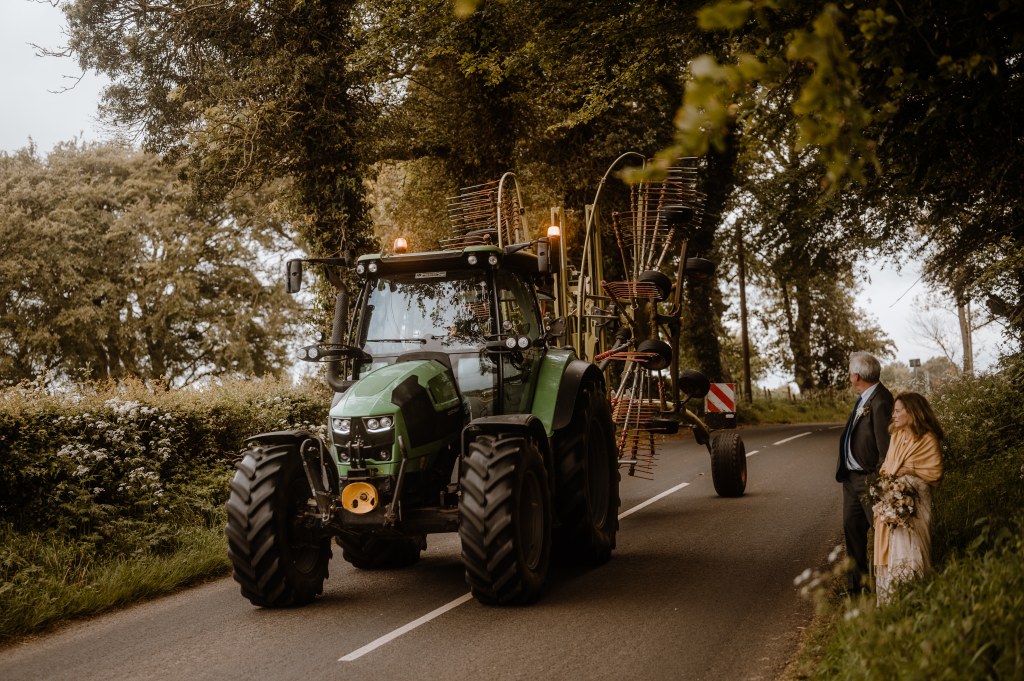
“Hero status” has been bestowed on me once or twice on this trip, but never has it been better timed nor better received than when, applying my mad navigator skills, I route Cathy thru Ballymoney, bypassing Coleraine and it’s diabolical multi layered roundabouts. 

I am her hero once again.

Four O’Clock: Farmer Sean

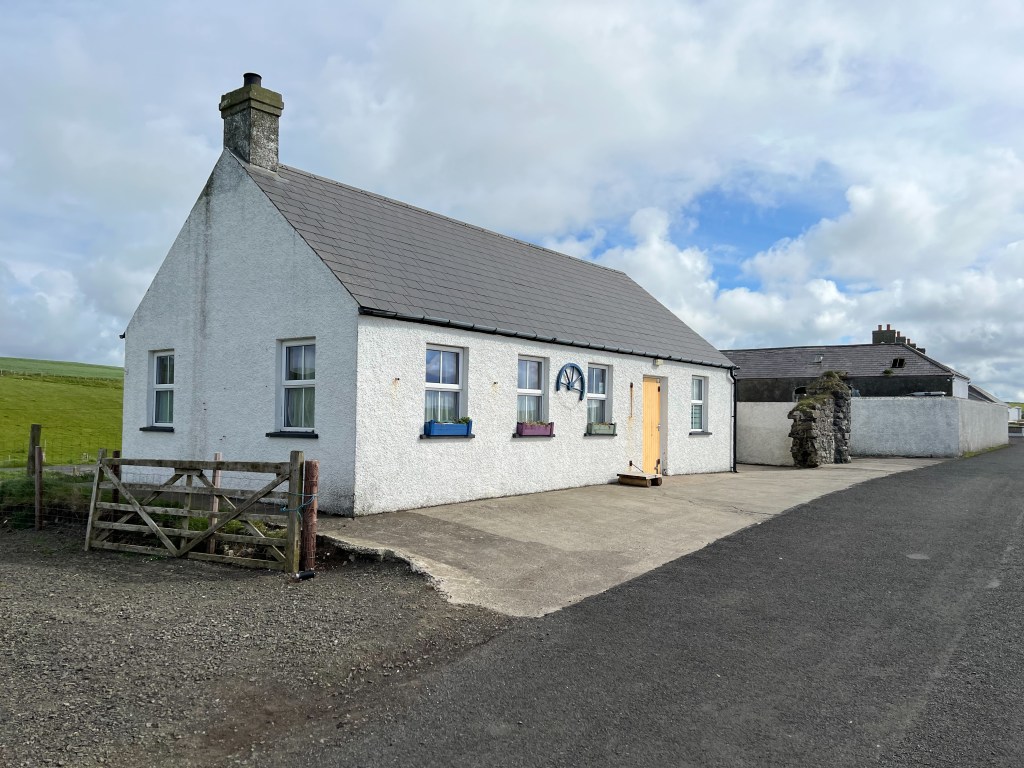
We are to meet Sam, the photographer Kelly, and the farmer Sean at a small cottage near the entrance to Dunluce Castle. Kelly has told us look for a yellow door. Sam has told us look for a red door.  This has me worried. I fear that, even if we find the right door, there will be a sea of tourists and little or no place to park. 

We pull in. It is a yellow door. Cathy performs a miracle parallel park  a bit down the road which, to have adequate room, requires that she snug the car up against a tall grass embankment on my side. The woman is amazing. In a wedding dress with high heels, she can parallel park on the left from the right side of the car.

She steps out. I struggle to crawl over the console, get my leg caught, and crawl out hands on the pavement, tie dragging, mortified as the passing tourists chuckle at the sight.

It is windy. I suggest Cathy wait in the back seat and promise to be right back. I walk up the hill to find a tall lean man with gray hair, his hands thrust deep into the pockets of his green working coat, standing outside the white cottage with the yellow door. I ask, “Sean?”. He asks “Robert?” 

         We step inside. He and his wife greet me. They are soon joined by Sam and his wife.  Kelly, the photographer—a kind young lady, dressed in a parka, with a ski cap pulled down over her ears, two cameras hanging from her neck, arrives. 

Sean and his wife, and Sam and his, have been married for many years. I ask Sam, an almost painfully shy man, “How long?” His wife rolls her eyes when he does the computation in his head. 

We chat for a few minutes, when Sam’s wife asks,  “Have ye forgot something, Robert?” I reach for the rings in my coat pocket, mortified that I have lost them, and reply, “No, I don’t think so.” Sean says, “yer bride Robert, yer bride.” 

         I say I will go fetch her. Sean, a prankster at heart, says “no, let me do it.” Out the door he flies as I say “she is sitting down the road in the back seat of a Mercedes. Sean shouts back over the wind, “I’ll find her” and takes off.

         Cathy is sitting in the back of the car wondering where I am when a strange man jumps into the front seat behind the wheel without looking back. He says, “hi” and tells Cathy “From the back I’m the spitting image of your husband to be.” Cathy, suspecting that it is Sean the farmer, replies “close, but not Rob.”

They return to the warmth of the cottage where Sean steps into the kitchen, return with two brandy sniffers and a bottle of Scotch. He pours two glasses to bolster us against the wind. We rib Sean that it is Scotch, not Irish Whiskey.

The ladies ooo and ahhhh over Cathy’s dress. Sam’wife—a short, solid, no nonsense woman with short gray hair– teases him, “How come, ye’ve never been so romantic?” Sam shrugs  and looks to Sean for help. The small cottage is filled with laughter. Sean hands Cathy and me a 20 euro note and makes us promise to buy two proper glasses of Irish Whiskey at our next pub as a wedding gift from him.

Half Past Four: “Here Comes the Bride”

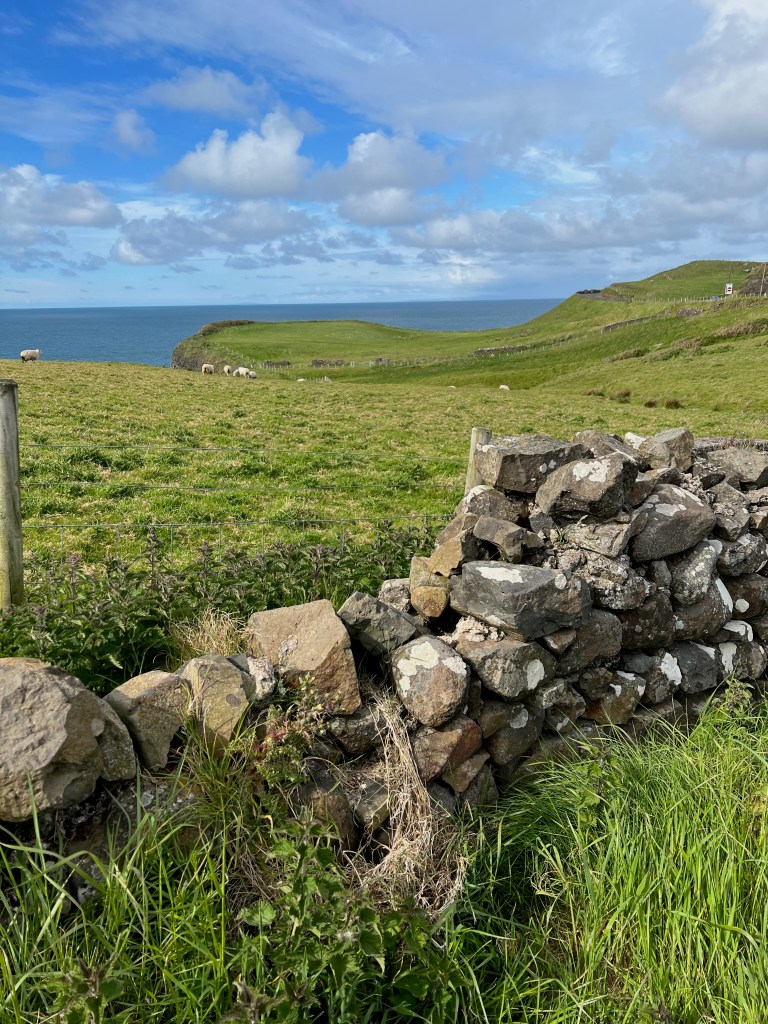
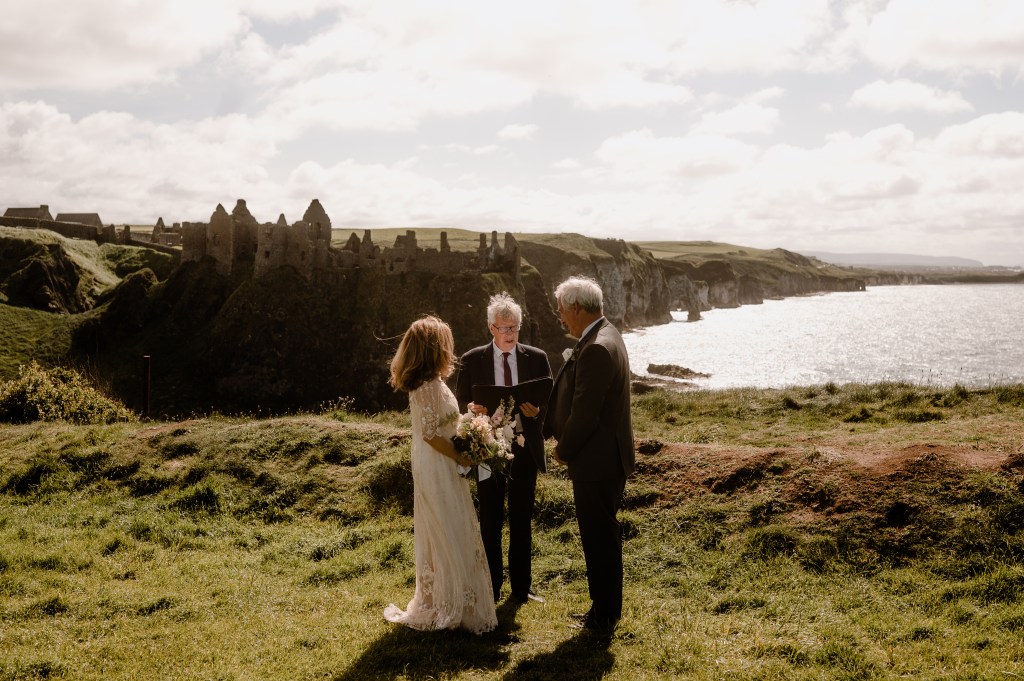
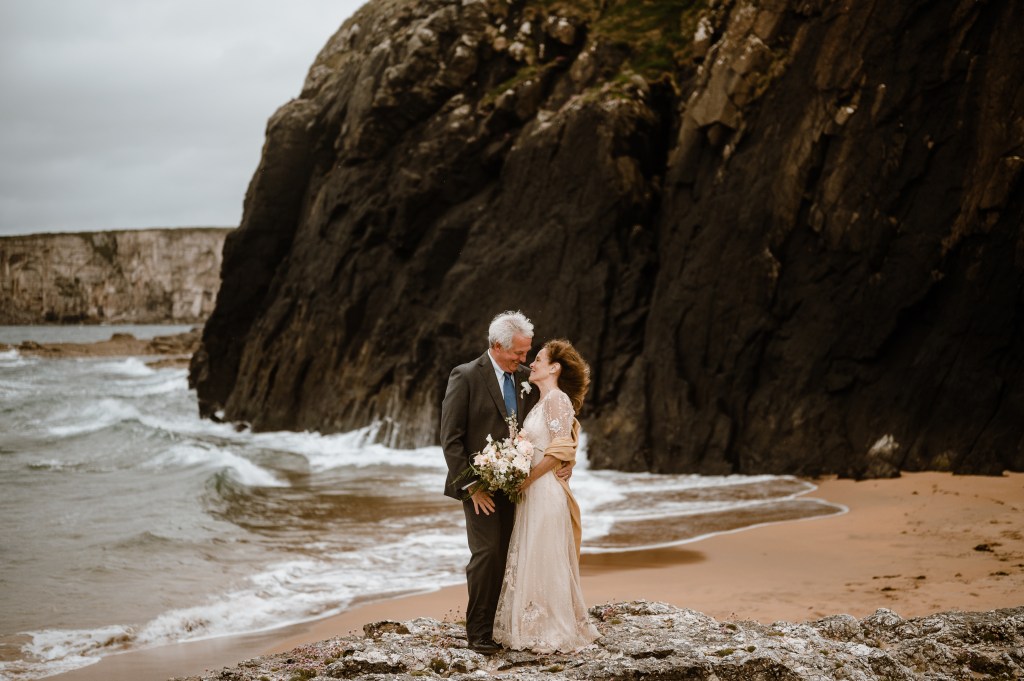
Our ceremony will take place on a bluff on Sean’s property. You can see it in the distance in this picture. Sean’s family has owned the property since 1957. 

Sean insists that Cathy remain behind as he drives me, Sam and Sam’s wife, and Kelly in his Volkswagen pick-up truck out to the bluff. I tease him, “You won’t lose my wife, will you?” He teases me back that “Not to worry Robert; if I do, it won’t be more than an hour or two.”

He drives back up the hill to fetch Cathy.

Most grooms stand by the minister as they watch their bride walk down the aisle. Sean had another entrance planned. As Sam and I stand, backs straight, our hands solemnly folded in front, Cathy makes her slow entrance in the front seat of a pick-up truck alongside Sean. What an entrance! She is  500 yards away and already I start to well up

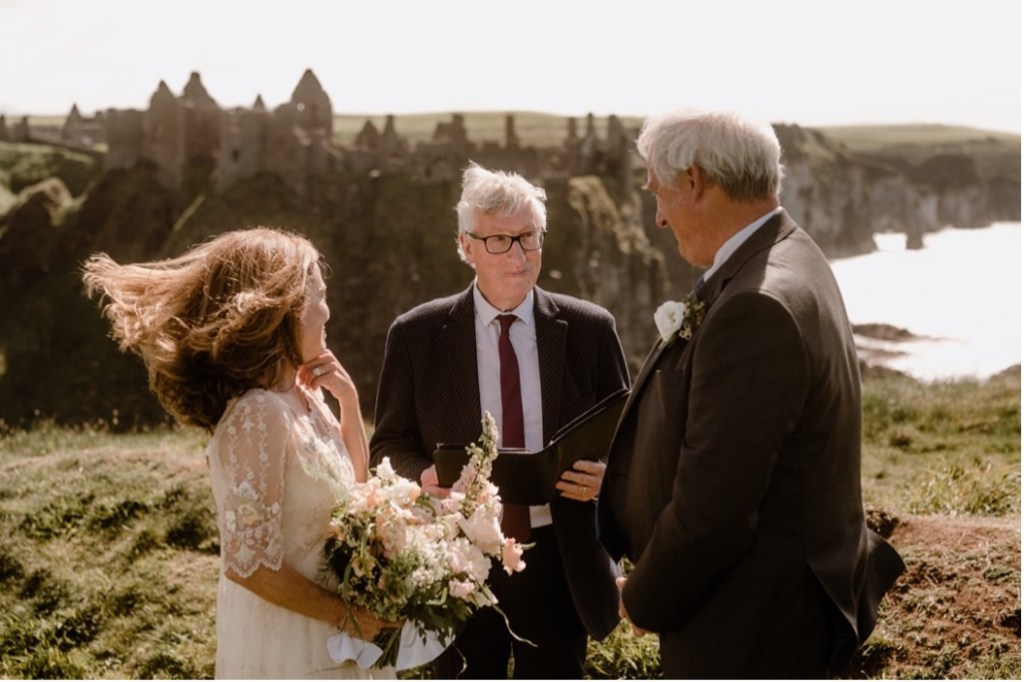
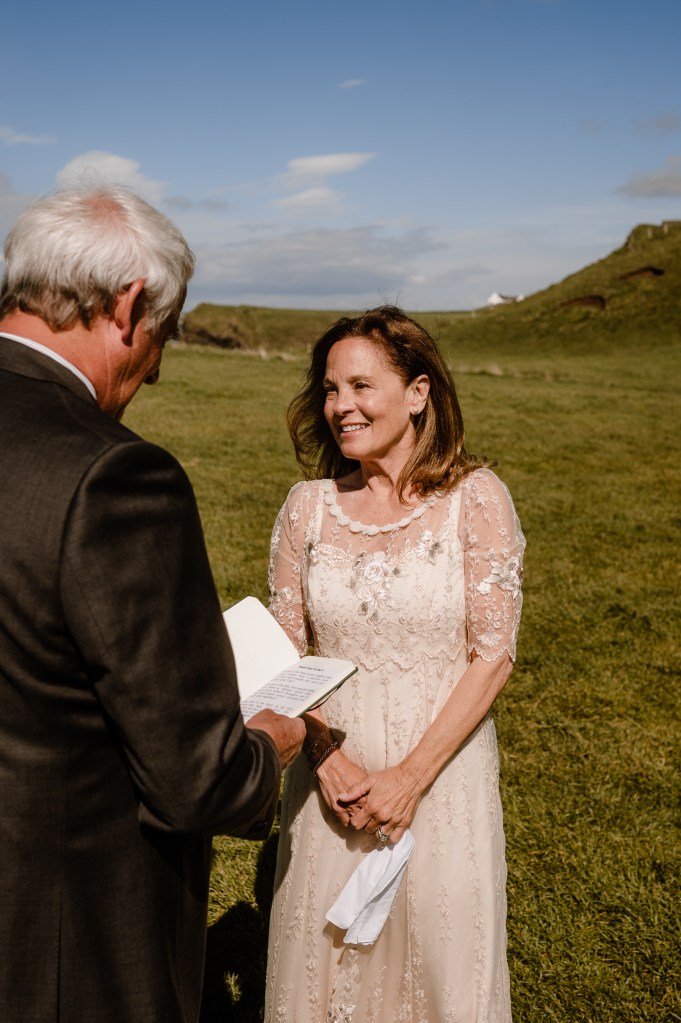
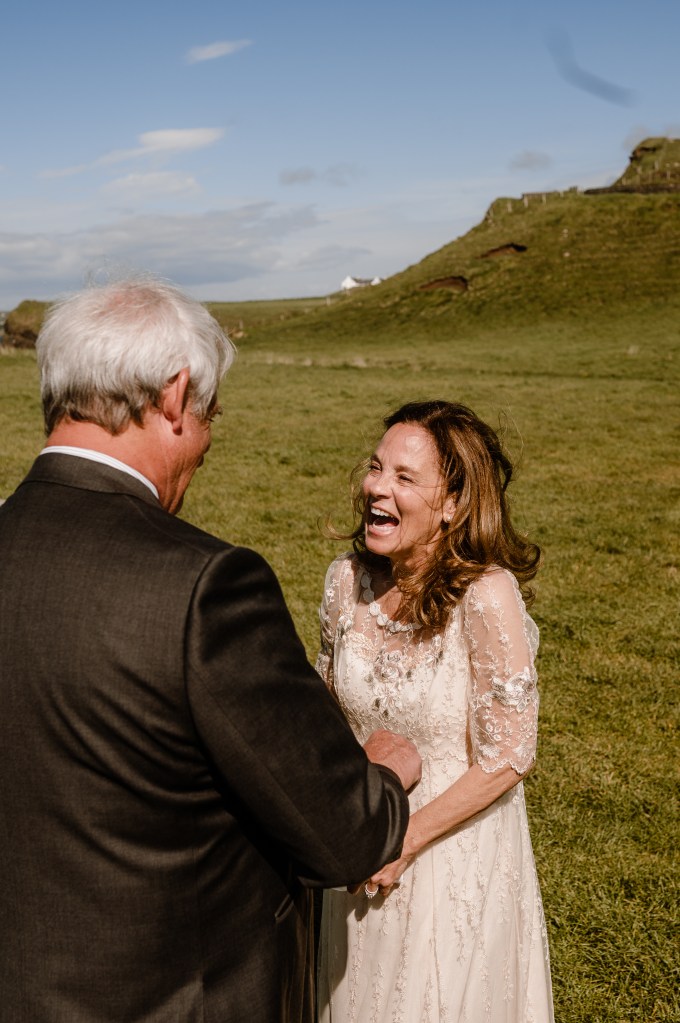
The ceremony is brief. Sam, with a soft Irish lilt, has done a masterful job of preparing just the right words, using the “stories” he asked us each to write, but not share with one another, and weaving those stories of how we came to fall in love with his own comments about marriage, poetry we selected, and just the right amount of humor. He has us both crying and laughing.

We exchange rings, say our “I do’s”. Kelly floats quietly about clicking photographs. She is a pro and does not intrude. I am scarcely aware that she is there. 

Sam’s’s wife stands back at a distance. She strikes me as not the kind to cry, but she does.  When Sam asks her to hand him the book in which we have written our vows, she is startled, having been lost in thought, and scrambles through the heavy grass to hand it to Sam.

I have to stop here. Although I can recount our vows, I cannot describe the look on Cathy’s face. I won’t even try. That will have to await Kelly’s photographs. 

Sam steps away some distance leaving Cathy and I alone to hear one another. We have typed our vows in large “easy reader” font in a small green journal with a Celtic knot on the cover, knowing that without our glasses and without large type, we will be unable to make them out.

Rob’s Vows to Cathy

How can it be that every night I fall asleep certain that I cannot love you more and awake the next day certain that I do?

How can it be that two people who have lived a lifetime apart can know each other’s thoughts as if they had spent every moment of every day together?

How can it be that, in all this beauty–the sea, the land, the sky—they all fall out of focus and the one thing that takes my breath away is the sight of you.

Because of you, Cathy, I no longer believe life is random. It’s more than fate. More than destiny.  It’s more than big G God, souls or faith. Those words  . . . any words . . . are leaden. They fall short, too heavy to ride the wind.

Meeting and falling in love with you Cathy have taught me there is an elegance to this universe that I can understand only if I accept impossibilities and I can glimpse only if I pause long enough to look at simplicities. 

I see it in 

  • The way you fall asleep with your chin back and your glasses tilted forward on your nose as if you were reading your dreams.
  • The way you position cartons and bottles and jars in the fridge so the labels face out;
  • The way you look for your glasses, not knowing a pair, sometimes two pairs, are perched on your head.
  • The fact that, right now, only you and I would wonder “Is it proper to say ‘two pairs of glasses or two pair of glasses’”;
  • The way in which you talk to dogs and babies as if they were the same;
  • The way your face lights up in the glow of your phone in a dark room and I know it is a video of Avery or Olive;
  • The way you look at photographs of Nick and get lost in memories
  • The way you hold your mother’s arm as she descends the steps;
  • The way your eyes mist up at the memory of your dad;

But if there is a god or a force or a cosmic answer in this world, I can hear it every day in the sound of your laughter. Your laughter and your smile are all that I want and all that I might ever hope for and. . . for me . . . the only necessary answer to the question “why.” 

And so I make this promise, Cathy

I shall shelter you against the wind,

And hold you close beneath the stars,

Stand watch against the dark of night,

And be there in the mourn.

I shall set my teacup softly down

Not to wake you ere you stir,

I shall kiss your forehead and your hand

And hug you tight against my heart.

I shall get down on these aching knees,

To build dollhouses for your girls,

Your family is my family now,

Your children now my world,

And each night that we climb the stairs,

My steps not far behind,

I shall whisper to my weary self,

Thank god, your love is mine.

Cathy’s Vows to Rob

We are finally back in Ireland, but this time together. It feels so right to be at this place, at this time, joining our lives together and creating a new loving family.

         I feel the presence of Gram and all of our loved ones that have passed away smiling down on us right now! They, along with our family and friends at home, have us in their hearts as we pledge our love to one another.

         I could never have guessed that fate and luck would join together, and I would find the love of my life at Trader Joe’s. We followed a crooked road to find each other, but I truly believe that our story was written in the stars a long time ago.

         Rob, you are simply the best man I know. I have such respect for you. You bring joy and laughter into my life and a love that I have not known before. You are full of kindness and intellect and humor. You challenge me, you encourage me . . . you comfort and protect me. 

         And, in return, I promise to stand by you through thick and thin and happy and sad. To be your refuge when the world seems dark and to be your confidant to safely share your thoughts. I promise to be your equal partner . . . sometimes to follow the course you set and sometimes to lead when you tire . . . but always by your side in this adventure together. I promise to never stop embracing this magic love we have found.

         And this final promise is the easiest . . . I promise to love you for ever and ever.  Of course

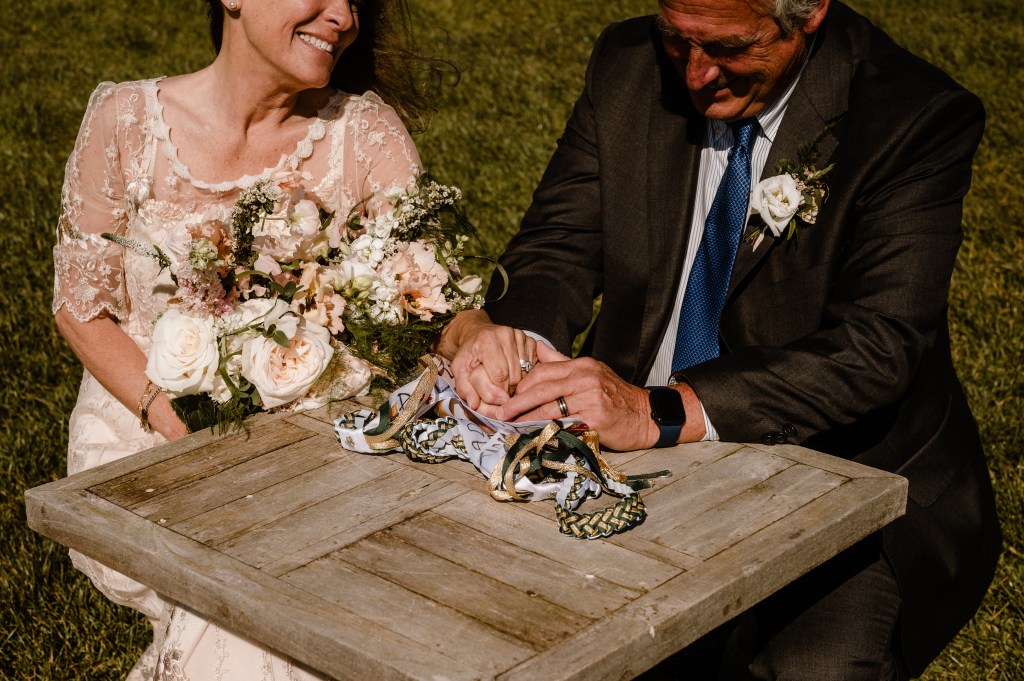
Rings exchanged, vows exchanged, Sam leads us through the handfasting ceremony.  Holding one another’s hands, he weaves the beautiful braid Cathy, Jackson, Avery, Finn, Grady, Olive and Rhyse have made, around each of our wrists. We officially  “Tie the Knot” in the Irish way.

Sam concludes with the Irish Blessing:

May the road rise up to meet you,

May the wind be always at your back, 

May the sunshine be warm upon your face,

And rains fall soft upon your fields,

And, until we meet again,

May God hold you in the hollow of his hand.

We kiss . . . and laugh.

Five O’Clock: Photo Ops

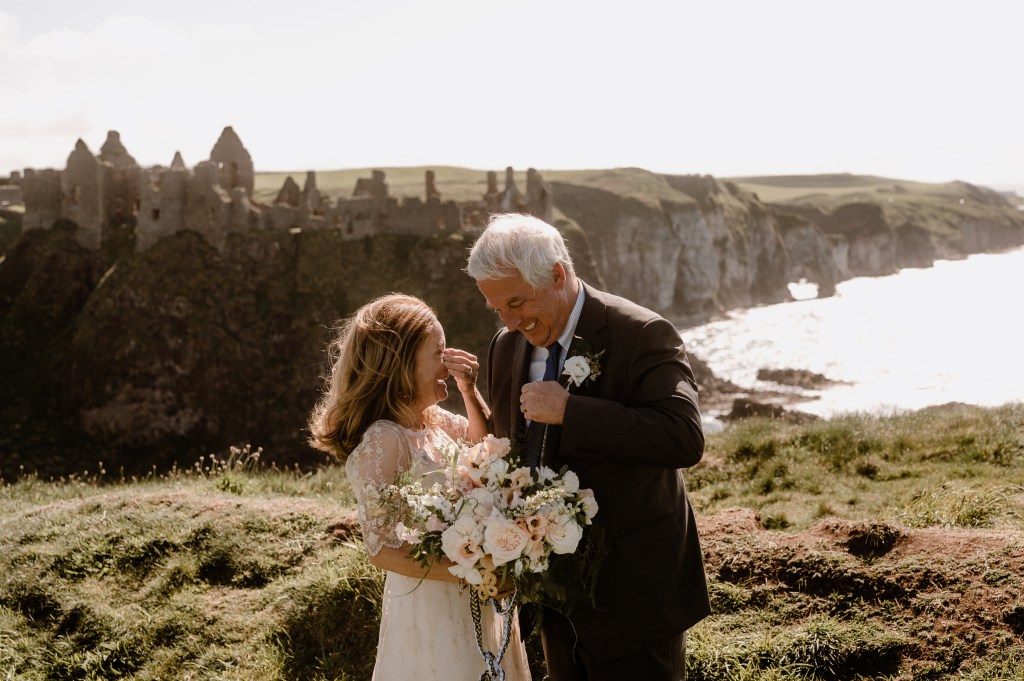
We are crying. Kelly agrees to take a couple of photos with our cell phones. We insist that Sam’s wife join us in a photograph. She refuses, embarrassed at her appearance, but we eventually prevail. 

Sean drives us all back to the cottage. We say our goodbyes.

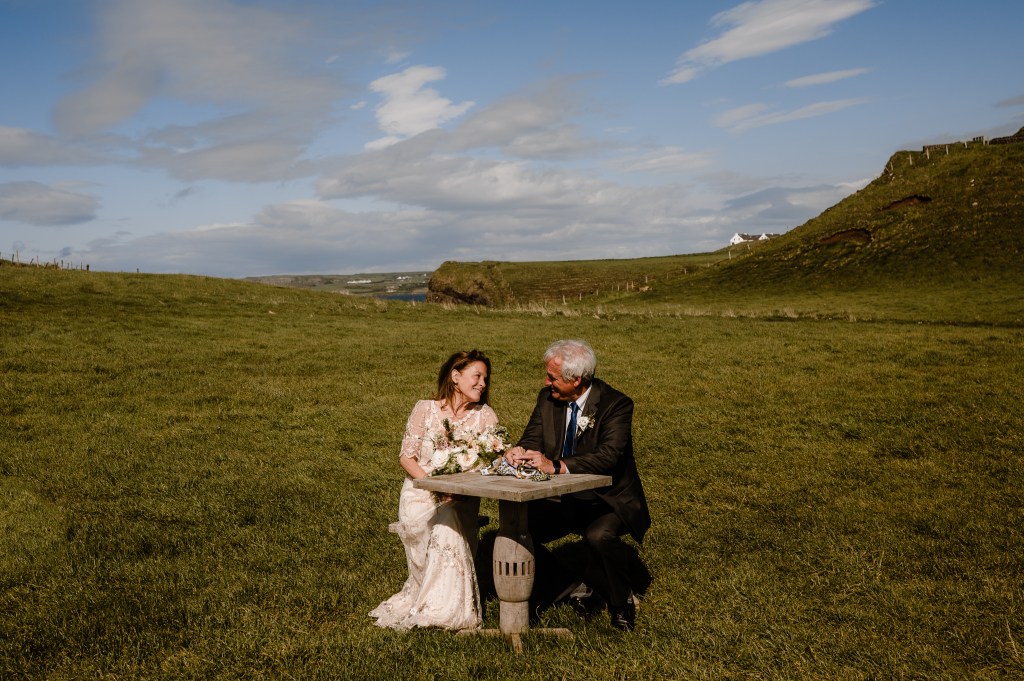
Kelly has selected three sites for photographs, each fifteen minutes down the road from one another. She leads in her car; we follow.

Kelly is sweetheart of a girl. She leads us through some steep and sketchy terrain, always solicitous, helping Cathy in her struggle, a hopeless struggle against the wind, to keep her hair off her face, reminding us that we don’t have to chance a shot near the edge of a cliff or a walk down a steep slippery slope. 

Cathy resists her entreaties to swap more stable shoes, preferring instead to scamper over rocks and pick her way down boggy slopes in high heels. As Cathy drives to the next stop, she empties sand from her shoes.

         First, we stop at Dunseverick, a beautiful sloping ravine to a hidden cove where the remains of a castle are perched on a bluff above.

Next it’s on to Ballentoy Harbor. 

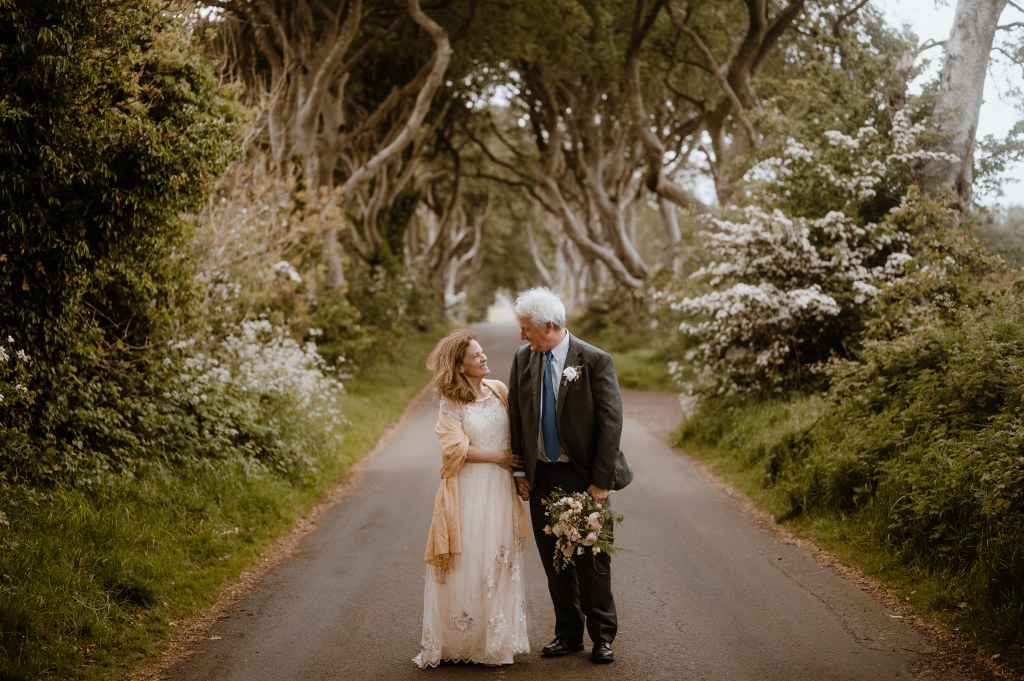
Finally, we stop at the Dark Hedges, a haunting tree lined road. Kelly has carefully timed our arrival for just before nightfall so as to avoid the crowds of Game of Thrown fans who come in busses dressed in costume. It is bitterly cold now and the trees a long walk away. Kelly is bundled in her parka; Cathy has nothing more than her shawl.

Half Past Eight: “The Coolest Grandparents Ever”

We walk back to the cars and say our good-byes to Kelly. She asks, “Ye two are grandparents, right?” We say “yes.” She comments that young couples have declined to go where we trapsed. As she opens the door to her car, she says, “You two are the coolest grandparents ever.”

It is late. The weather which had held throughout the day is beginning to turn wet and gray. Cathy is freezing. My climate control skills are not much better than my navigating skills, but I manage to crank up the heat in the Mercedes. 

We meander through the countryside and find a roadside Italian restaurant Kelly has recommended. It is not elegant. Not one tourists frequent. The folks are local families, casually dressed, familiar to one another, out for a Sunday dinner.

As we go inside, Cathy in her dress, me in my suit and tie and boutonniere, a buzz spreads through the restaurant. A young waitress with a kind smile approaches. The place is set to close at nine. Everyone is finishing their dessert. We ask if we might sneak in a bite before they close. She replies, “Of course, not a bother, tat all.”

We each order lasagna which arrives piping hot and delicious, but a serving so large that one could feed a family of four. Between us, Cathy and I have enough food to feed an army. We stuff ourselves so as not to appear rude, then ask for a box. The waitress returns with the box and two small bottles of champagne she has lifted from the back, clearly without getting approval. 

I excuse myself to the bathroom. The moment I do, the waitress is joined by the other waitresses and girls on the staff, all crowded around Cathy, gushing over her dress, peppering her with compliments and questions. As each staff member rushes over, a new round of “Oh, that’s just so romantic” starts up again.

Eleven O’Clock: Home Again

We drive “home” to find wink and a nod Sean has chilled the champagne and arranged our flowers. We add the two small bottles of champagne from the restaurant to Sean’s whiskey money, Sam’s carefully prepared transcript of the ceremony, the other Sean’s newly cut flowers from the Ardtara garden, and our handfasting braid. So many well wishes of so many kind strangers.

We fall asleep without so much as a sip of champagne. It has been a picture-perfect day.

I think I’ll have the French Toast tomorrow.
“Is Your DNA Tuning Fork Vibrating?”

May 31, 2022

Gone are the stone walls of County Down. Newly mown fields and hedgerows mark the land in County Armagh.

Today, Cathy and I drive west in search of Ballyhagen, where my great-great-great-great-great-great grandfather Isaac Jackson . . . so we believe . . . set forth with four sons in 1713 bound for western Pennsylvania as part of Ireland’s first great wave of emigration.

Now bear with me Jacksons; you know this part. This is where the Perrys have some catching up to do.

What we know, or think we know, is debatable. Some clues suggest the Jacksons were Presbyterians who hail from a mythical town called Vermuth in County Armagh. This may have been a mistake of a great uncle, our family’s historian, as despite scouring 18th century maps of County Armagh, and consulting Feargal O’Donnell, an Ulster genealogist, there is not a trace of such a town. The only town in Armagh that as much as begins with a “V” is Vinecash, in the farmland northeast of Armagh City.

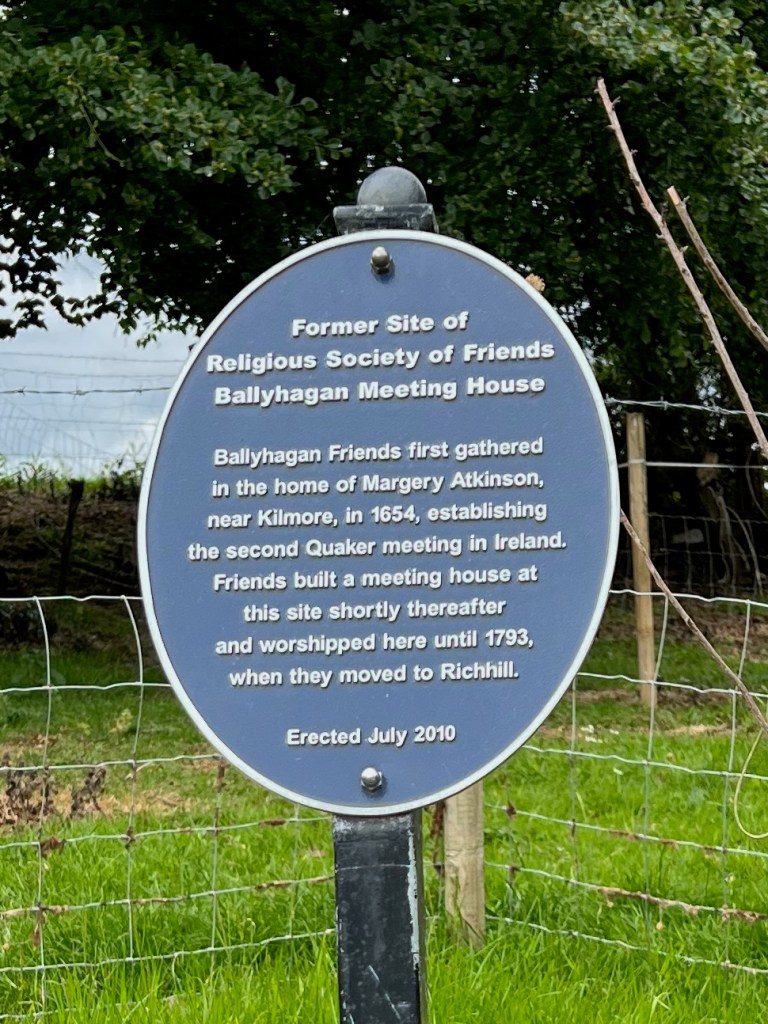
The other working theory is that the Jacksons, before converting to Presbyterianism in Pennsylvania, were Irish Quakers. Quaker records confirm that in fact four families left County Armagh in 1713. Their meeting hall was in a hamlet called Ballyhagen; interestingly, just a few hillsides away from Vinecash.

         Cathy is a picture of patience as her increasingly unable navigator has her winding narrow country roads. We pull into a parking lot next to a farm to nibble on my ham and cheese sandwich which the kind lady in Armagh has lathered with so much mayonnaise . . . butter was my other option . . . that, despite occasional problems swallowing, I am certain I will have no problem getting down.

         As I get out of the car to ask around, I drop my Coke bottle. The carbonation is too much for the cap I forgot to sinch down, and Coke is sprayed all over my side of our ride. Cathy, I can tell, despite her patience, is skeptical of this goose chase, but when I suggest we grab some pictures and call it a day, she encourages me on.

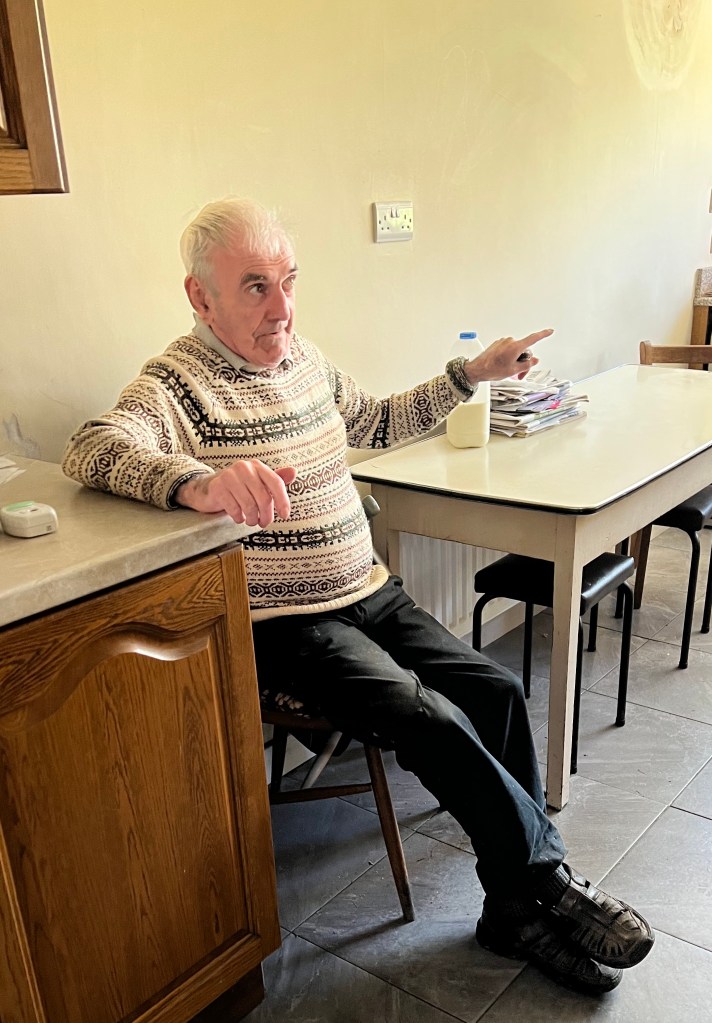
         Across the parking lot, a lean man my age, dressed in a gray sweater and black pants is chuckling with two younger men, having witnessed my Coke bottle fiasco. He looks like a cross between Paul Hogan of Crocodile Dundee and Bill Nighy as Billy Mack in Love Actually. He approaches to help. I feel like an idiot, but walk to meet him halfway, leaving Cathy by the car.

I ask if he might mind if Cathy and I park on his lot for a bit of lunch. Seamus . . . his name is Seamus . . . says, “Not at all.” I explain why we are here and ask if he knows where Ballyhagen might have been. He says, “This is Ballyhagen; you’re standing in it.”

 He says there are Jacksons up near Portadown, but none nearby. We agree it is a common name. I share what I know, or think I know. He pauses, smiles, and asks, “Did ye say 1713?” When I say yes and begin to apologize for wasting his time, he ponders, “My, that’s a long time ago.” 
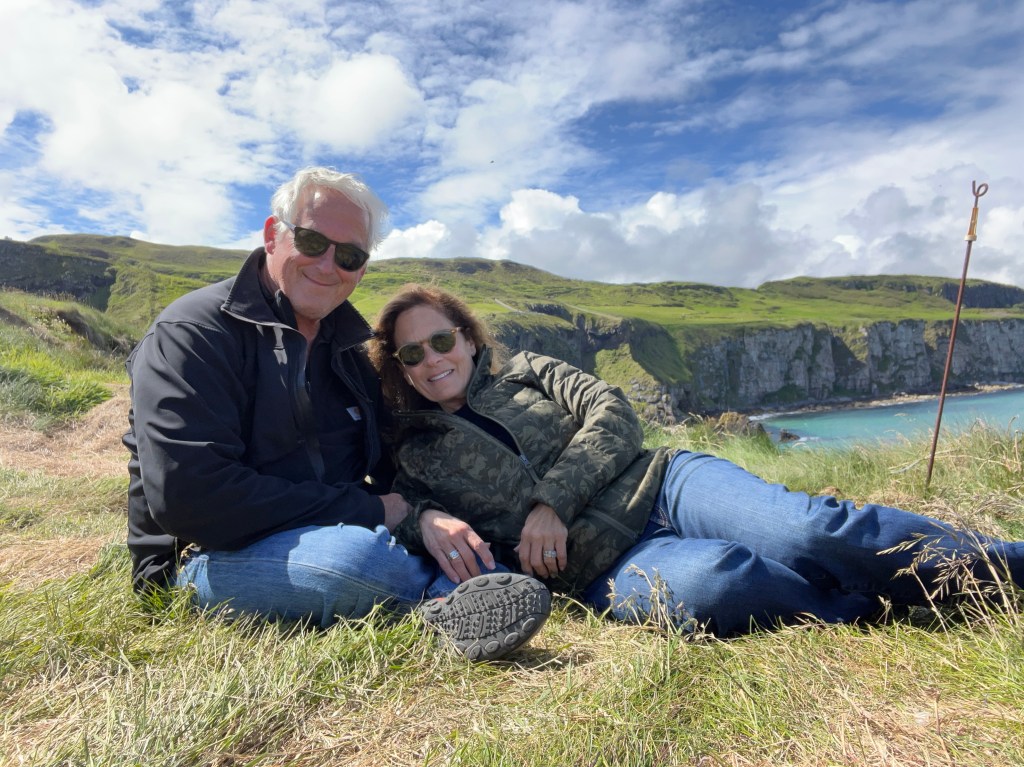
I say “Well, thank you for your kindness. We won’t be long with our lunch” He asks “Are ye a Quaker?” I answer like the idiot I am now convinced that I am and fear that he is now concluding as well, “I’m not sure; I might be.” He takes hold of my elbow and says, “Come with me.”

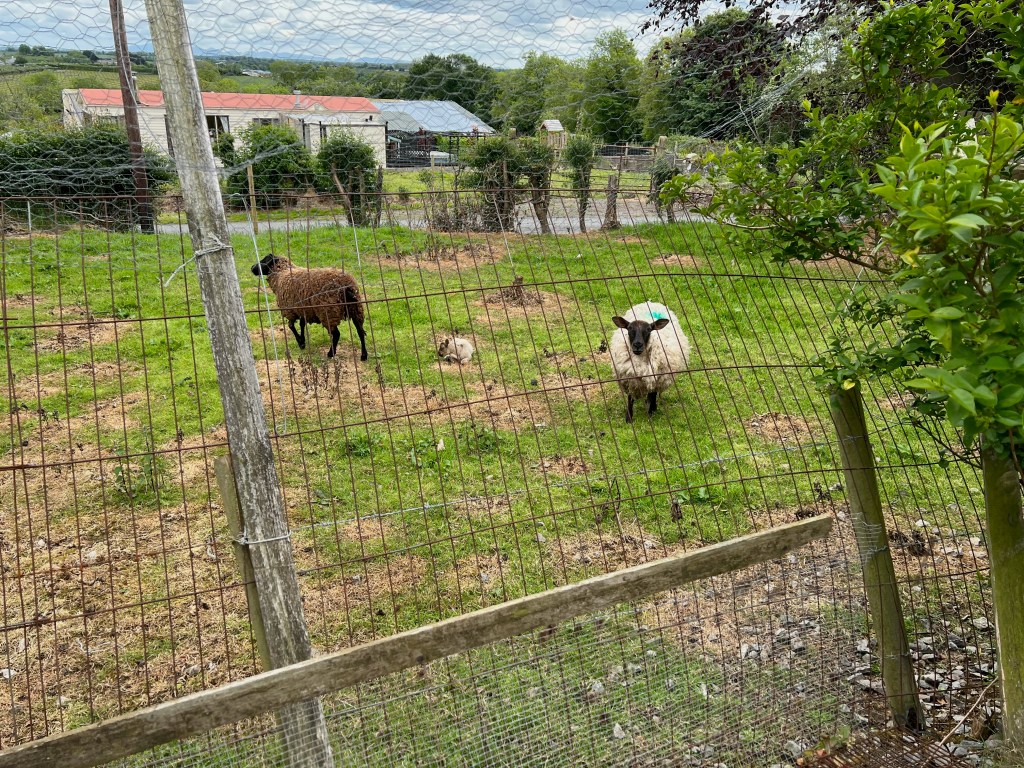
We round behind his barn and pointing through a wire fence toward a small flock of sheep in a depression behind, he says, “That was the old Quaker graveyard, but the gravestones are now long gone.
I extend my thanks. He wishes me good luck. I return to the car,  tell Cathy what I’ve learned and, satisfied that “well, we’re at least in the same neck of the woods”, suggest we be on our way.

         Cathy says, “not so fast” and suggests we look around a bit more. We leave the car behind, walk to the road I had glimpsed on the far side of the sheep. I relay how Seamus said this was once a graveyard. We wander a bit further. The sheep rush to meet us, bleating up a storm. As Cathy reaches out to greet them, I look to the far side of the small enclosure and see a sign.

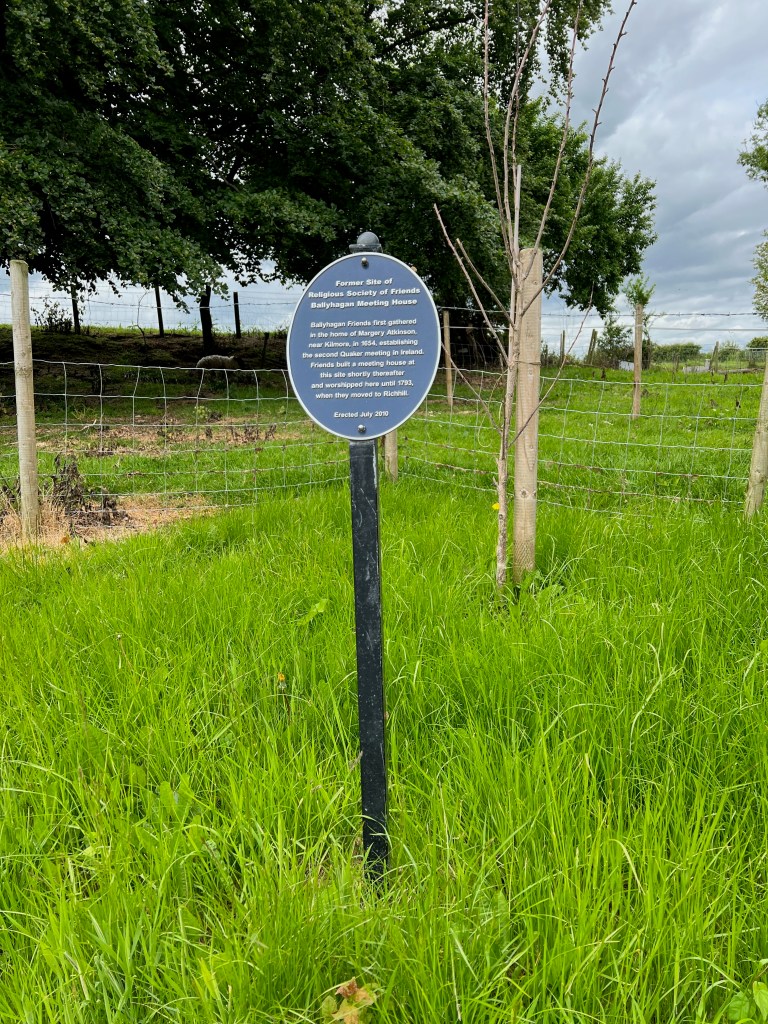
         Neither of us have our glasses and it is, at first, hard to make out. Cathy asks, “Is your DNA tuning fork vibrating?”

         It is.

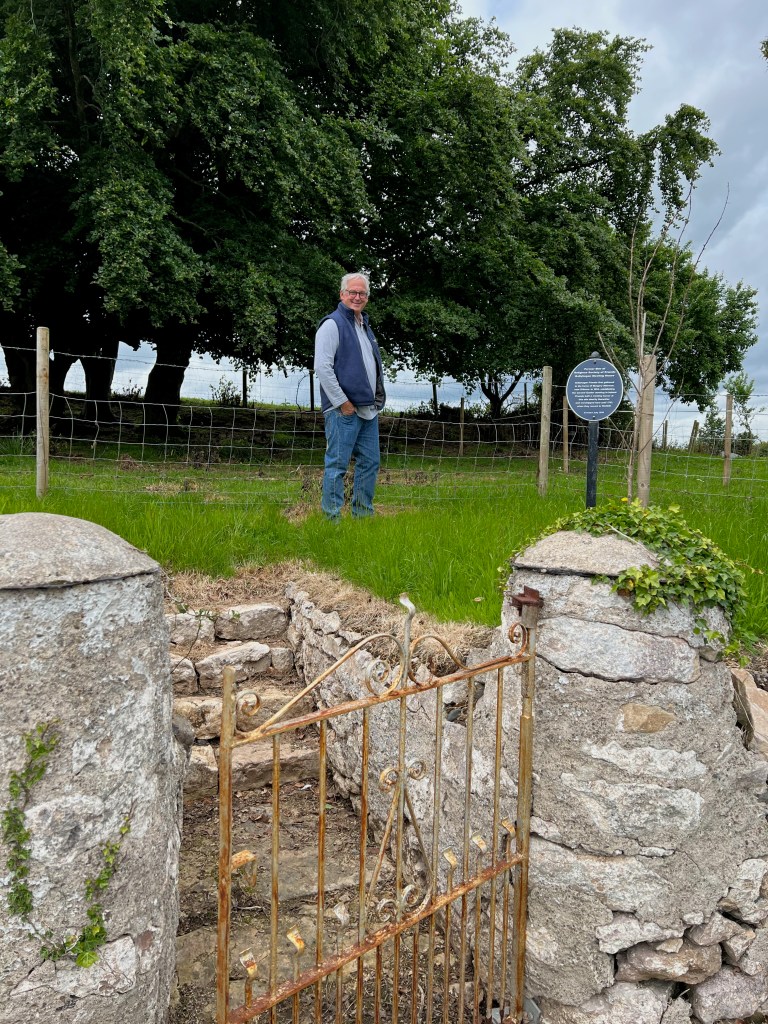
Next to the old graveyard, crumbling, but not yet giving way to the weight of the ivy overgrowing it, we find the old Meeting Hall that, if in fact the Jacksons were Quakers, Isaac likely last visited in 1713 before leaving with his wife and sons for America.

We laugh that Cathy found family in County Down and all I found were a bunch of sheep. But, that’s okay. That somehow seems fitting.

We drive a bit further in search of a “newer” Quaker Graveyard Seamus had explained was “two roads down on your right and over a wee bridge.” We look but cannot find it. We pass by a woman and ask if she might know of it. She says no, but kindly says, “Let me call me mum; she’s a Quaker; she’ll know.” She does, but her “mum” doesn’t know of any graveyards in the area. We thank her. 

I plug in the coordinates for Ardtara on Google Maps. It’s an hour away. We’re getting married tomorrow and don’t want to be late to meet our officiant. 

A Wee Bit of Melancholy

May 31,2022

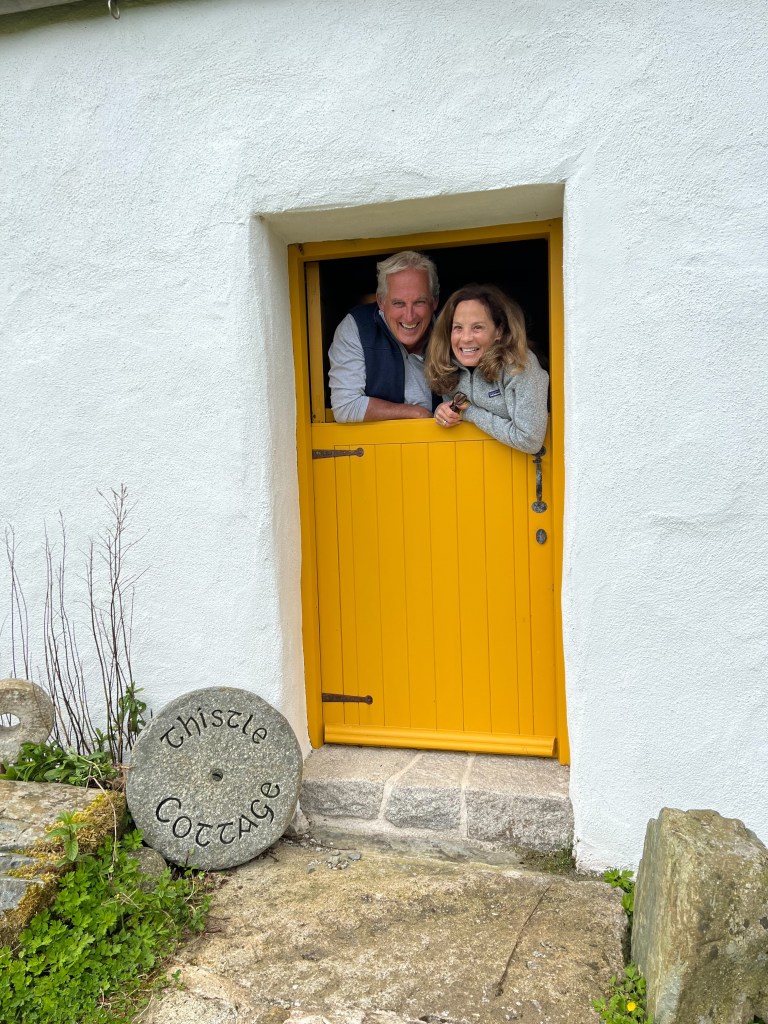
As Cathy and I tidy up the Thistlethatch, pack our bags, load them into the car, and look out from the Dutch door in the kitchen on the valley below, we comment how difficult it must have been to emigrate, as the owner of this home once did.  This seems particularly true for those who left for Australia or America, land so vast, brown, and dry. 

No wonder the Irish are prone to reminisce and drink. Memories like this must have been a comfort . . . and a torment.

Screenshot

The owner Andy is late. So Cathy and I walk to the far corner of the property behind the cottage where Andy has hung a swing on a tree near a rock wall. We agree a good swing ride cures what ails you and takes you back to your childhood. For Cathy, she is seven. Me? I’m wondering how strong the limb is.

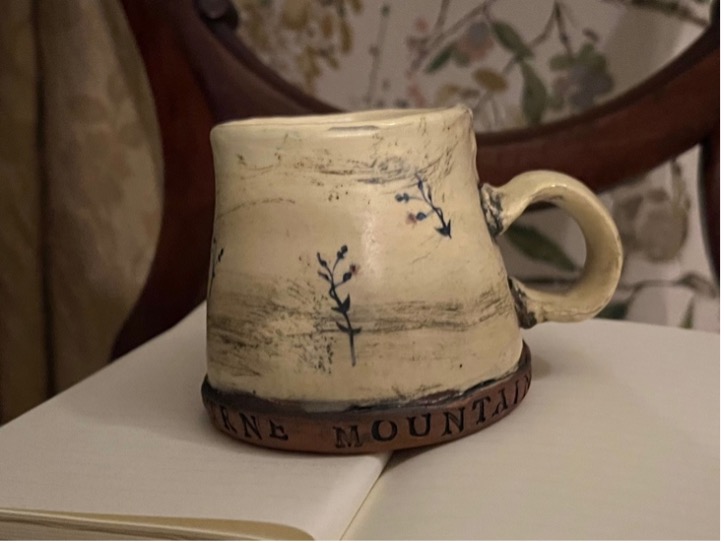
Andy arrives. He presents us with a coffee mug he had made for guests as a thank-you, asks if we have heard the cuckoo bird, once common, now rare, but recently rediscovered near the cottage on early mornings. When we hesitate, Andy seems dumbfounded, mutters “Have ye not heard of a cuckoo bird?” and pulls his phone from his pocket to look up the cuckoo’s call. We glance at one another as if it is a trick question and, while Andy works his phone, Cathy interjects “Is it the same as the sound of a cuckoo clock?” This thought has curiously never occurred to Andy and he is tickled when, playing the bird’s call on his phone, he realizes, as we all do, the connections we never make in life.

Andy tells us of his efforts to find Rooneys that might be related and shares how tickled his mother was last night when he told her of the American couple staying in the cottage before going on to the North Coast to be married.

I find a handful of wool a sheep has left on the wire across the road trying to wiggle beneath. I give it to Cathy as a souvenir of the cottage.

I suppose it’s the Irish in me. It seems no matter how bright the horizon and the promise that lies beyond, we can’t help but feel just a wee bit of melancholy leaving a place we have grown to love, if just for a short while. I look out to the valley beyond the swing, and as I do, the warmth on my face of a soft good-bye gives way to a cold wind that knifes beneath my coat and whispers in my ear

         “Take a moment . . . you’ll not likely return.”

“And Know the Place for the First Time”

May 30, 2022

In 1955, a wee bit before Cathy was born, a fella named Bob Paige . . . this handsome fella . . . hosted a daytime television program called “The Big Payoff.”

Now, right about now, you’re wondering what does a fifties game show have to do with a trip to Ireland, Rob? 

It does, trust me. You’ll see.

 The idea behind “The Big Payoff” was that men . . . well, actually, husbands . . . would become contestants by writing a letter telling Bob why their wives deserved a prize, usually a fur coat or a trip. If his letter was persuasive, a lucky contestant was invited on the show where the “Question Girl”, the lovely Susan Sayers, would present him with a silver tray on which rested four written questions. Answer correctly, and he’d win his wife a mink or maybe an all-expenses paid vacation.

I know what you’re thinking . . . Rob? Ireland? Your trip?

Now see, right there I can tell you’re not thinking like an Irishman.  If you were, you’d remember “Pains and patience would take a snail to America.” I’m not exactly sure what that means, but I think it has something to do with “no tale worth telling can be told in a hurry.”

Where was I? Oh yeah . . .

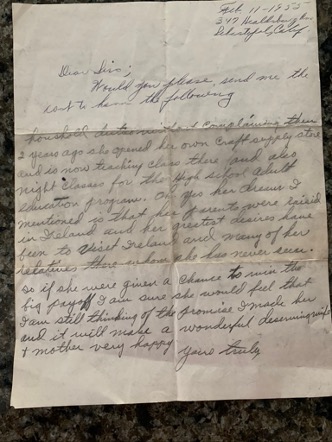
On February 11, 1955, about the time Patti was three and Bob was seven months old, and Cathy was still a twinkle in her dad’s eye, Cathy’s Grandpa, Chet Ihinger, wrote to Bob Paige trying to persuade Bob why his wife Josephine, Cathy’s beloved Gram, deserved a prize. This is the letter.

In the letter Chet explained that not only did Josephine do “household duties without complaining” but opened her own craft supply store and taught night classes for Analy High School’s adult education program.

         Chet went on to say:

“Oh yes, her dream I mentioned is that her parents were raised in Ireland and her greatest desires have been to visit Ireland and many of her relatives there whom she has never seen. So, if she were given the chance to win the Big Payoff, I am sure she would feel that I am still thinking of the promise I made her and it will make a wonderful deserving wife and mother very happy.”

Now, stick with me Jacksons; the Perry Clan knows this stuff by heart. You’ll need a bit more.

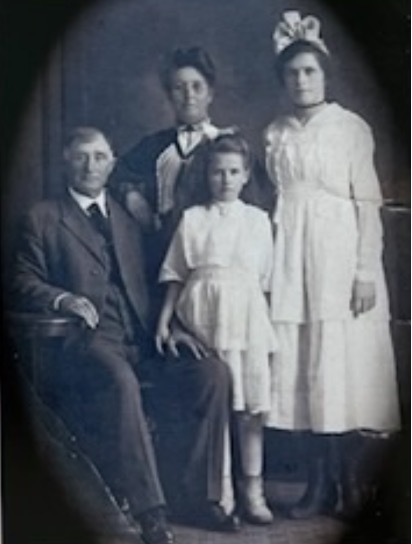
 Gram was born Josephine Rooney to John Rooney and his wife Cecilia McKibbin. That’s Gram in the middle. John and Cecilia were born and raised in Ballymartin in County Down on the coast of the Irish Sea.  

This morning Cathy and I look down from the Dutch door of the Thistlethatch Cottage toward the sea beyond. Our plan is to find some Rooneys and McKibbins and, god willing and the creek don’t rise, make good on Grandpa’s promise to Gram.

We’ve got only one clue. An address. 107 Ballyveaghmore Road. 

Pilot to Navigator; work your Google Maps magic, Rob.

Rob:           “I think this is it, Cath. That red door down there. Wdya say? 

Cathy:         “Let’s go knock.” 

We drive up the long lane. An old man peers out the window, half curious, half concerned. We walk around the house to the back door. He greets us and without so much as a “May I help you?” invites us in.

         We explain that we’ve come from the States, that we understand that Rooneys once lived in this house, that we imagine they’ve long since moved, and ask if he knows of any Rooneys in the area. 

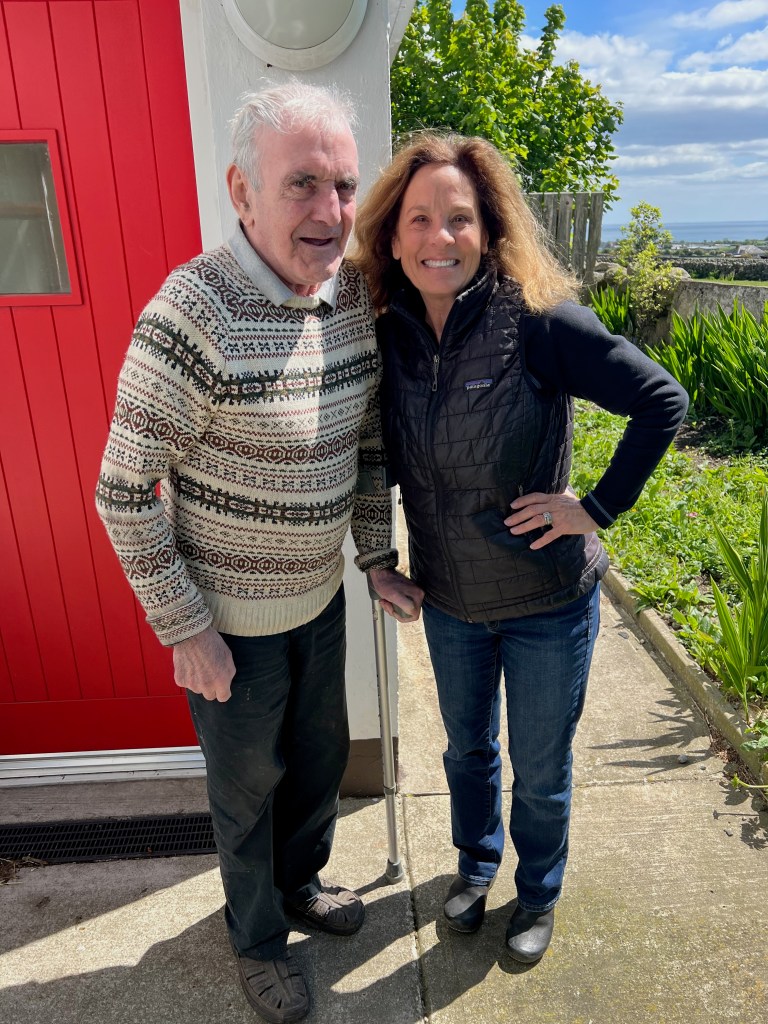
He says, “I’m a Rooney.”

         We introduce ourselves. He does as well. Leo Rooney is his name. We show him pictures of John Rooney, Cathy’s great grandfather. He studies the photograph, looks up, smiles as if he has heard a joke we haven’t, and says, “that’s my father.” 

He suffers from emphysema and apologizes that he must frequently take a draw on his nebulizer before stringing a sentence or two together. We tell him we don’t mean to intrude and won’t take his time. He looks hurt at the suggestion and a bit embarrassed that only his failing memory and failing breath keep him from telling the long story the story deserves.

         Cathy asks if he might know an Eddy Pat McKibbin, a cousin her aunt met in Ballymartin 40 years ago. He allows as how Eddy Pat “just passed away”—we learn later when we find his gravestone in the graveyard aside St. Joseph’s in Ballymartin that what Leo means “by just passed away” was twelve years ago.

“That’s a shame”, we say. He reaches for his nebulizer, takes a hit, waits to catch his breath, then says, “But his widow lives out on Longstone Road.”  We share that she must be elderly and, what with Covid and all, she may be reluctant to come to the door. He tells us “She isn’t that old; she’s ninety.”

I am better than Cathy at “interpreting” a deep Irish brogue, but I’m not certain, as he gives directions, if he is describing a stone wall lined road or using the proper name of the road. He gives us directions which neither of us can hardly understand and certainly will not remember, but we are reluctant to have him repeat himself, what with his shortness of breath.

We make our way to the front door. He points out a foal of his niece and a foal of his own in the pasture next to the house.  He sees Cathy knows horses, and  reminds us—how true it is I don’t know and don’t really care—that a horse’s legs as a foal are as long as they will ever be. He repeats it with a smile.

We say our good-byes. He wishes us “safe journey.” Cathy pauses at the bottom of the lane as I pull up Google Maps.  Turns out Longstone Road is a stone’s throw away.

         We pull into a string of small shops and agree Cathy will try the ladies in the hair salon and I’ll try in the mini-mart. Cathy has a talk with a kind lady, her hair in metal foils. I chat with a nice lady behind the counter. Both tell us Leontia is on in years and point out where she lives. 

         We again get lost, uncertain which house matches what they described. An elderly couple is walking their dog on the lane; we stop to ask if they know where Leontia might live. They explain, almost giddy to help two Americans, that they are not from the area, but know that a granddaughter cares for an elderly woman in the house just across the street.

         We ring on the bell, explain to the granddaughter why we are calling. She invites us in as if we were family. There is the living room is Leontia McKibbin and a gentleman caller. 

Screenshot

He teases her that he is after her beauty and her wealth. She laughs silently. She allows as how about once a year “some relative from America comes visiting.” We tell him we have come from Leo. He gives a look like Leo might imbibe just a wee bit and might not to be the most  reliable historian, saying “Just what did he tell ye?”

We stay for a bit and then make our way to the graveyard. (a word I find the Irish prefer to “cemetery) at St. Joseph’s Church on the coast road. We wander about, taking care not to step on a grave. The graveyard is filled with Cunninghams (another branch of Cathy’s family tree) but, try as we might, we can’t find the grave of Eddy Pat McKibbin.

Then, just at the last minute as we are walking to the car, there right in front of us rests Eddy Pat McKibbin of Longstone Road.

It’s late at the Thistlethatch. The summer solstice is near. The days are long. The sun sets well after 10:00. Cathy has spent the day hoping to find just the right spot in which to bury a copy of the letter her Grandpa wrote sixty-six years ago to Bob Paige hoping to win the Big Payoff for the woman he loved.

T.S. Elliot was right, 

“We shall not cease from exploration, 

and the end of all of our exploring 

will be to arrive where we started 

and know the place for the first time.”

Cathy found the right spot for her grandpa’s letter. It’s beneath a tea kettle, high above the Valley of the Annalong River, in the shadow of Slieve Donard and the Mourne Mountains.