What’s In a Name?

Wednesday,

October 29, 2014

Santa Rosa, CA

As was the custom in the fifties when my brother, sister and I were born, my parents drew on family heritage to name their children. My brother, the oldest, was predestined long before conceived to become John Calvin Jackson, IV. That’s“the fourth”,with a comma in front of it. (Not everyone gets a “comma.”)

John’s son is “,V” and his grandson is  “ ,VI.”  Who knows what number he might have drawn had it not been for Rossanah Murphy–a pistol of a pregnant Catholic Irish lass who back in 1828 threw down her apron, said “Jesus, Joseph and Mary,” and, foregoing the first choice so as not to piss off the Presbyterians, and the last choice so as not to piss off  . . . well . . . more Presbyterians, passed on yet another John Calvin and opted for the second choice , naming  her son Joseph.  I would have liked to have known Rossanah. She must have been a spirited woman to buck a bunch of humorless John Knox disciples stuck in their Protestant ways.

My sister Linda, bless her heart, was given the middle name Louise.  I’m not certain, but I believe this was in deference to an aunt in East St. Louis, my only memories of whom are that she played Beethoven with such lightning like fingers that she could pull the Chesterfield King that seemed to perpetually dangle from the side of her mouth, tap the ashes into one of those beanbag ash trays on the side of the piano, and return her fingers to the keyboard without missing a measure.  The name Louise was, in its day, a regal and popular name (in 1910, one in ten American girls was born Louise), but as with so many names, it fell out of favor, passed from sight, and like the names John, Linda, and Robert became “old fashioned.”

My mom used to remind me when I was a child, “Rob, don’t ever make fun of someone’s name or the way they look; they can’t help what God gave them when they were born.”

I don’t know about God’s participation, but Mom was right: we are born with the name our parents chose. Sometimes with rhyme, sometimes with reason, often with neither. Sometimes a name is a source of comfort. Sometimes a source of pride. Sometimes an inspiration. Other times an embarrassment, a mystery, or a burden

The dirty little secret that only parents know—and we’re sworn by some unspoken covenant amongst ourselves to never share with our children– is that we really don’t know what the hell we’re doing. We’re rookies.  There were no minor leagues in which to practice. No spring training. All of the sudden we’re thrown in the “bigs” thinking “I’m not supposed to be here; I shouldn’t even be in right field.”

And the very first job we are given—our very first assignment– is to give this short story fresh out of the womb, not just a working title, but one suitable for framing on a college diploma, having no idea what the hell the book is going to be about. Think about it.  It’s the name with which she will be scolded in second grade. It’s the name by which he will be asked to step out of the car by the officer when making out with his girlfriend in high school. It’s the name by which he’ll swear to take her and protect her in sickness and in health, and the name that will eventually end up in the local paper’s “Tribute Section.” (Apparently, someone decided “Tributes” with color glossies of the dearly departed sell better than the old black and white, copy only, “Obits.” Newspapers, these days: it’s all about visuals and revenue.)

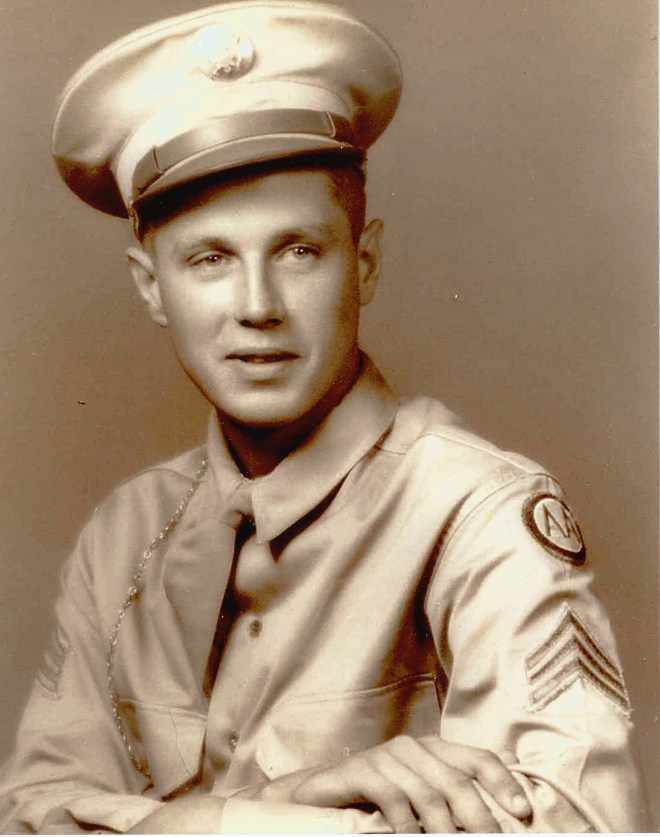
Anyway back to the point. My name is Robert Lear Jackson. I was named after this handsome young man who was my mother’s brother. We never met. He died “Somewhere in Luxemburg” on October 22, 1944. Nobody knows where precisely.
Scan 493

Uncle Robert

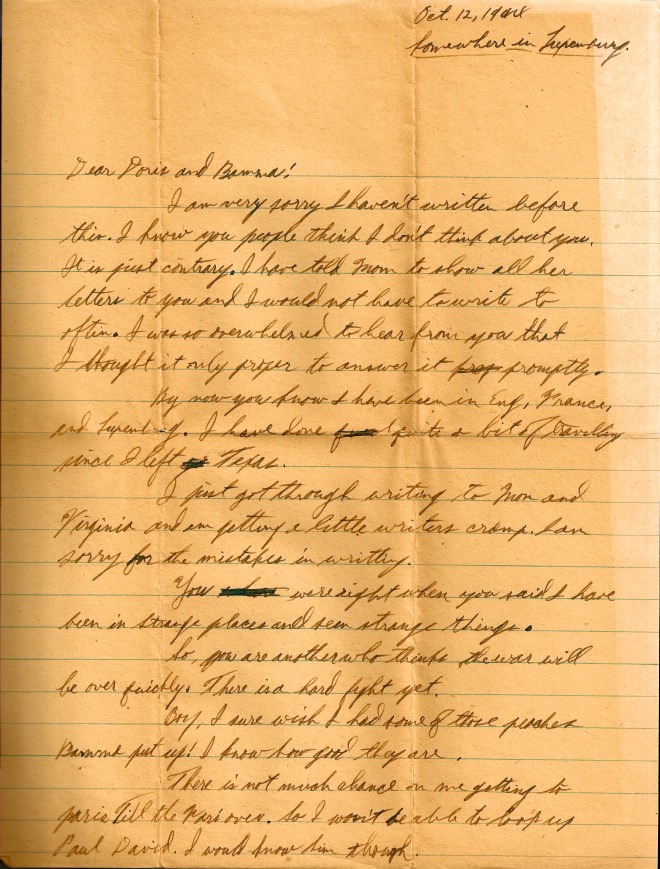
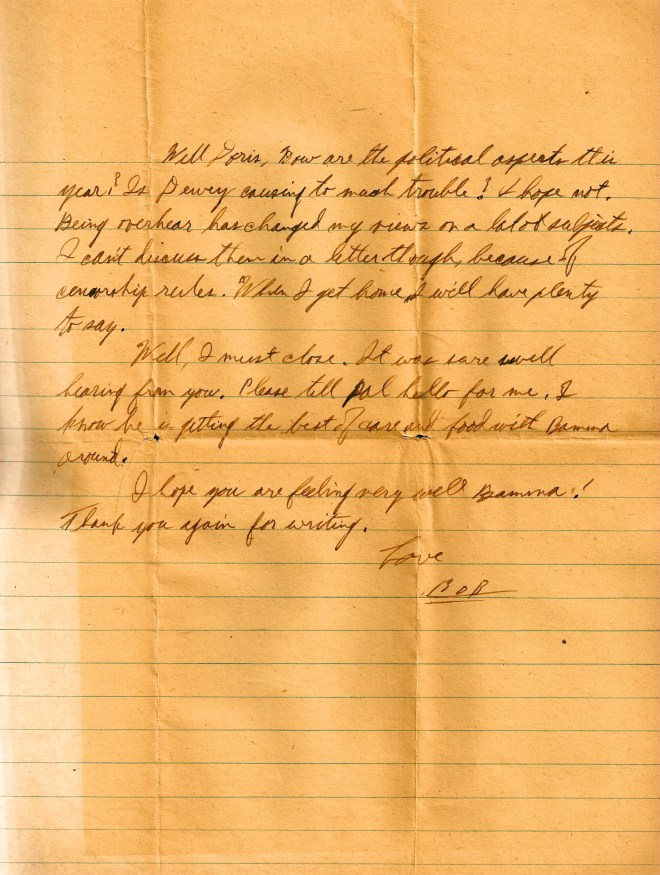
This is a letter he wrote to his Aunt Doris and grandmother (“Bawma”), ten days before he died
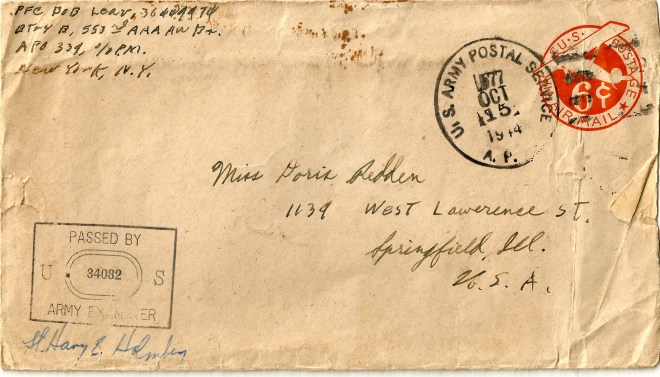
 

Uncle Robert Letter 2


Uncle Robert Letter 

“Somewhere in Luxemburg”


Uncle Robert Letter 1

Love, Bob


October 12, 1944

Somewhere in Luxemburg

Dear Doris and Bawma,

I am very sorry I haven’t written before this. I know you people think I don’t think about you. It is just the contrary. I have told Mom to show all her letters to you and I would not have to write too often. I was so overwhelmed to hear from you that I thought it only proper to answer it promptly.

By now you know that I have been in England, France and Luxemburg. I have done quite a lot of traveling since I left Texas. I just got through writing to Mom and Virginia and am getting a little writer’s cramp. I am sorry for the mistakes in writing. You were right when you said I have been in strange places and seen strange things.

So, you are another who thinks it will be over quickly. There is a hard fight yet. 

Boy, I sure wish I had some of those peaches Bawma put up. I know how good they are. There is not much chance of me getting to Paris until the war is over. So I won’t be able to look up Paul David. I would know him though. Well Doris, how are the political aspects this year? Is Dewey causing too much trouble? I hope not. Being over here has changed my views on a lot of subjects. I can’t discuss them in a letter though, because of censorship rules. When I get home, I will have plenty to say.

Well, I must close. It was sure swell hearing from you. Please tell Pal (his dog) “hello” for me. I know he is getting the best of care and food with Bawma around. I hope you are feeling very well Bawma. Thank you again for writing.

Love,

Bob

I’m going to find “Somewhere in Luxemburg” or at least get close.  I’m not entirely certain where, and to be honest, I’m not entirely certain why. It is not important that I find the exact place where my Uncle perished.  I’m not expecting answers. Hell, I’m not even sure what the right questions are.

I’m not doing this in a maudlin or morbid way. I intend to have a good time, see the Paris Uncle Robert never got a chance to see, and pay my respects to him and others who gave so much at such a tender age.

Names are important. They serve to foreshadow our lives, even when cut short. They challenge us to learn, to travel, and to step outside the comfort of our home to meet the hopes and expectations of our parents, as proper . . . or misplaced . . . as they may sometimes be. And if we are fortunate to live a long life, and respond to the challenges our names summon us to meet, perhaps one day our own name may encourage and challenge our children and their children and all the Roman Numerals that might follow to travel to places, both near and far, they might otherwise have never found the courage to explore.


Getting the Words Right

Pic


Saturday,

October 25, 2014

Santa Rosa, CA


I am searching for the words to describe why I am going to Paris for the first time at the age of fifty-eight. Trying to find the right words to write is apparently not uncommon in Paris.

What I know of Paris is only what I’ve read. I read once that Hemingway, bundled up in that iconic cowl neck sweater in a cold drafty apartment at 39 rue Descartes, working on the final chapter to A Farewell to Arms, scribbling in pencil, wrote 41 endings to the novel. Forty-one? Damn, that’s a lot of pencil lead. Years later, when asked why it took so long to erase so much, he simply said “I couldn’t get the words right.”

I read once where Hemingway taught his friend Ezra Pound to box in the living room of Pound’s small studio apartment on the rue Notre Dame des Champs. Ezra, who in 1945 was held captive in a circus cage in Pisa for having the poor judgment to pick Hitler and Mussolini to win, place, or at least show in WWII, first wrote 30 lines to describe the beautiful faces he saw stepping from a train in the Place de la Concorde metro station. He crumpled that up, tossed it in a waste basket, waited six months, honed it down to 15 lines, threw those in a bin, waited another six months and finally settled on fourteen words: When asked why so long to write a poem so short, he said, I don’t know how to paint and “I couldn’t find the words.”

Not so much, Victor Hugo.  Hugo had no trouble finding words. Words, words, and more words.  The poor bastard must have suffered from chronic, if not disabling, writer’s cramp. At his home near the Place des Vosges, Hugo crafted . . . and I use the term “crafted” with a hint of sarcasm. . . a generous 823 word sentence and buried it deep in Les Miserables. Hugo’s syntactical answer to “Where’s Waldo”

Just think of the ink.

Apparently Hugo did. He once stared into his India #2 and wrote “This ink, this blackness from whence emerges a light.”  Hmmmm?   I don’t know. All I can say is . . . “Eventually Vic . . .eventually.”

But then Hugo was a piker compared to James Joyce.  The poor man, damn near blind, wandered around his flat on the Rue de la Universite, wrapped in a blanket, peering out from behind dark glasses, scribbling triple puns in Swahili on scraps of paper he left scattered about the floor where his toddlers were playing. Can you imagine the kids looking up  to see dad chuckling to himself when he came up with what he thought was a particularly “good one.”

For years Joyce worked on Ulysses, creating a novel spanning a single day in the life of an Irishman. He crammed the story with so many historical and literary allusions that, while it was greeted by the enlightened as the greatest novel of the 20thCentury,  most readers  . . . you remember them; the ones who actually try to read the damn thing . . . find it incomprehensible.

Even as an adult, Joyce was so frightened, so terrified, so thunderstruck by . . . uhhhhh . . . well . . .thunder, that he skipped “kaboom” and “kablammy” and opted instead for a 100 letter word to describe it:

Bababadalgharaghtakamminarronnkonnbronntonnerronntuonnthunntrovarrhounawnskawntoohoohoordenenthurnuk

And if that wasn’t enough (the concept of “enough” was a wee bit lost on Joyce), he set the World Land Speed Conciseness Record by clocking a sentence in at just under 4392 words. Think of that. Your average non speed reader tops out at about 300 words a minute. (Those of us who still move our lips, probably 200). To read that one sentence by Joyce . . . and let’s just dispense right now with any silly notion of comprehension . . . would take just shy of 15 minutes.  That’s not a stream of consciousness; it’s a torrent, a bloody river. We’re talking Biblical flood.

So apparently, I’m not alone in trying to find the right words. And hell, I haven’t even left for Paris yet.

I’m 58 years old.  Joyce was dead at 58.  Pound was broadcasting for the Fascists when he was 58 destined to be tried as a traitor and spend 12 years in a mental hospital.  F. Scott Fitzgerald died 14 years shy of 58 when his Olympic liver couldn’t keep up with his Olympic drinking. And Hemingway?  At the age of 58, he mojitoed out of Cuba, underwent electroshock therapy at the Mayo Clinic, and a couple years later blew his brains out.

So why go?

Well, I am going to Paris (and I use the passive “I am going” intentionally) because I want to follow the November footsteps of Hemingway “down past the Lycee Henri Quatre and the ancient church of St. Etienne-du-Mont and the windswept Place de Pantheon and cut in for shelter to the right and finally come out on the lee side of the Boulevard St. Michel, work down it past the Cluny and the Boulevard St. Germain until I come to a good café . . . a pleasant café, warm and clean and friendly . . . on the Place St. –Michel . . . order a  café au lait . . . take out a notebook from the pocket of my coat, a pencil, and start to write.”

I am going to Paris because I want to run my fingers over the bookshelves that Pound hand planed for Sylvia Beach at Shakespeare and Company because he couldn’t make a friggin centime on his poetry (apparently he was paid by the word) and Sylvia was the only one who thought the autobiographical hand-job Joyce recounted from his first date with his wife to use as inspiration for a scene in Ulyssesshouldn’t destine a great, if unreadable novel, to the overstocked obscenity bookshelves in the U. S. Postal Service at the time.

I am going to Paris to find the bathroom, if it still exists, at the corner of the rue Jacob and rue des Saint-Peres where Scott Fitzgerald was so upset by a comment Zelda made belittling the size of his manhood that he insisted Hemingway join him, size him up, and reassure him that he measured up in ways more important and probably more profound than the length of his novels. I’m going to find that bathroom and . . . well . . . take a pee.

And . . .

I am going to Paris to follow the path of a young man named Robert Lear who, 70 years ago in November of 1944, passed through Omaha Beach without firing a shot, rode onto Paris peering, no doubt in wonder, from the back of a transport truck,  found his way a few days later on a muddy country road somewhere east of Arlon, Belgium, near the border of Luxembourg, and a day shy of turning 20-years-old, jumped from the back of that truck to push aside a friend who had fallen into the path of the truck that followed, and died.

I’m going to follow my namesake, as I always have, and try to find the right words to tell him thank you and good-bye.