May 30, 2022

In 1955, a wee bit before Cathy was born, a fella named Bob Paige . . . this handsome fella . . . hosted a daytime television program called “The Big Payoff.”
Now, right about now, you’re wondering what does a fifties game show have to do with a trip to Ireland, Rob?
It does, trust me. You’ll see.
The idea behind “The Big Payoff” was that men . . . well, actually, husbands . . . would become contestants by writing a letter telling Bob why their wives deserved a prize, usually a fur coat or a trip. If his letter was persuasive, a lucky contestant was invited on the show where the “Question Girl”, the lovely Susan Sayers, would present him with a silver tray on which rested four written questions. Answer correctly, and he’d win his wife a mink or maybe an all-expenses paid vacation.
I know what you’re thinking . . . Rob? Ireland? Your trip?
Now see, right there I can tell you’re not thinking like an Irishman. If you were, you’d remember “Pains and patience would take a snail to America.” I’m not exactly sure what that means, but I think it has something to do with “no tale worth telling can be told in a hurry.”
Where was I? Oh yeah . . .
On February 11, 1955, about the time Patti was three and Bob was seven months old, and Cathy was still a twinkle in her dad’s eye, Cathy’s Grandpa, Chet Ihinger, wrote to Bob Paige trying to persuade Bob why his wife Josephine, Cathy’s beloved Gram, deserved a prize. This is the letter.
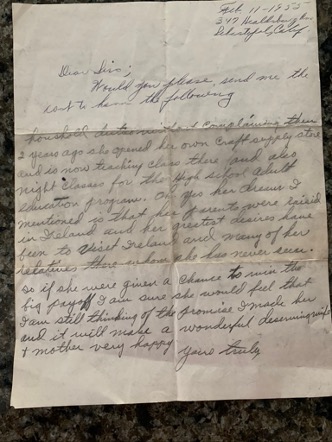
In the letter Chet explained that not only did Josephine do “household duties without complaining” but opened her own craft supply store and taught night classes for Analy High School’s adult education program.
Chet went on to say:
“Oh yes, her dream I mentioned is that her parents were raised in Ireland and her greatest desires have been to visit Ireland and many of her relatives there whom she has never seen. So, if she were given the chance to win the Big Payoff, I am sure she would feel that I am still thinking of the promise I made her and it will make a wonderful deserving wife and mother very happy.”
Now, stick with me Jacksons; the Perry Clan knows this stuff by heart. You’ll need a bit more.
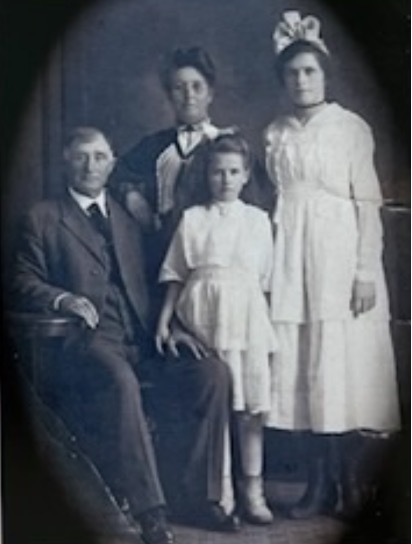
Gram was born Josephine Rooney to John Rooney and his wife Cecilia McKibbin. That’s Gram in the middle. John and Cecilia were born and raised in Ballymartin in County Down on the coast of the Irish Sea.
This morning Cathy and I look down from the Dutch door of the Thistlethatch Cottage toward the sea beyond. Our plan is to find some Rooneys and McKibbins and, god willing and the creek don’t rise, make good on Grandpa’s promise to Gram.

We’ve got only one clue. An address. 107 Ballyveaghmore Road.
Pilot to Navigator; work your Google Maps magic, Rob.
Rob: “I think this is it, Cath. That red door down there. Wdya say?
Cathy: “Let’s go knock.”
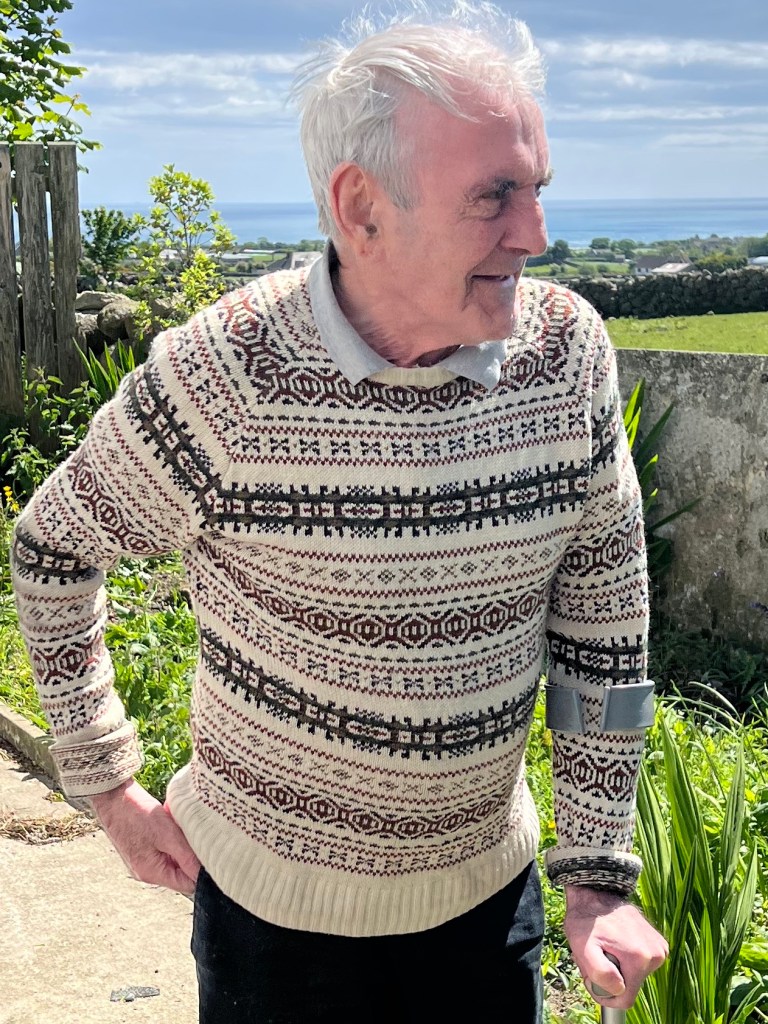
We drive up the long lane. An old man peers out the window, half curious, half concerned. We walk around the house to the back door. He greets us and without so much as a “May I help you?” invites us in.
We explain that we’ve come from the States, that we understand that Rooneys once lived in this house, that we imagine they’ve long since moved, and ask if he knows of any Rooneys in the area.
He says, “I’m a Rooney.”
We introduce ourselves. He does as well. Leo Rooney is his name. We show him pictures of John Rooney, Cathy’s great grandfather. He studies the photograph, looks up, smiles as if he has heard a joke we haven’t, and says, “that’s my father.”
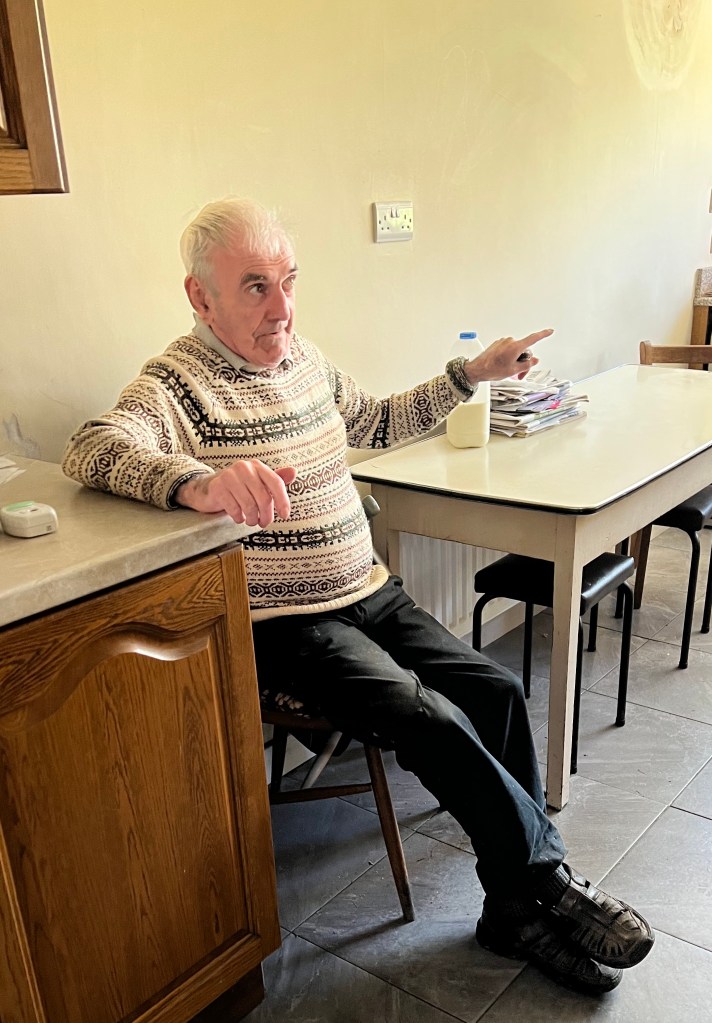
He suffers from emphysema and apologizes that he must frequently take a draw on his nebulizer before stringing a sentence or two together. We tell him we don’t mean to intrude and won’t take his time. He looks hurt at the suggestion and a bit embarrassed that only his failing memory and failing breath keep him from telling the long story the story deserves.
Cathy asks if he might know an Eddy Pat McKibbin, a cousin her aunt met in Ballymartin 40 years ago. He allows as how Eddy Pat “just passed away”—we learn later when we find his gravestone in the graveyard aside St. Joseph’s in Ballymartin that what Leo means “by just passed away” was twelve years ago.
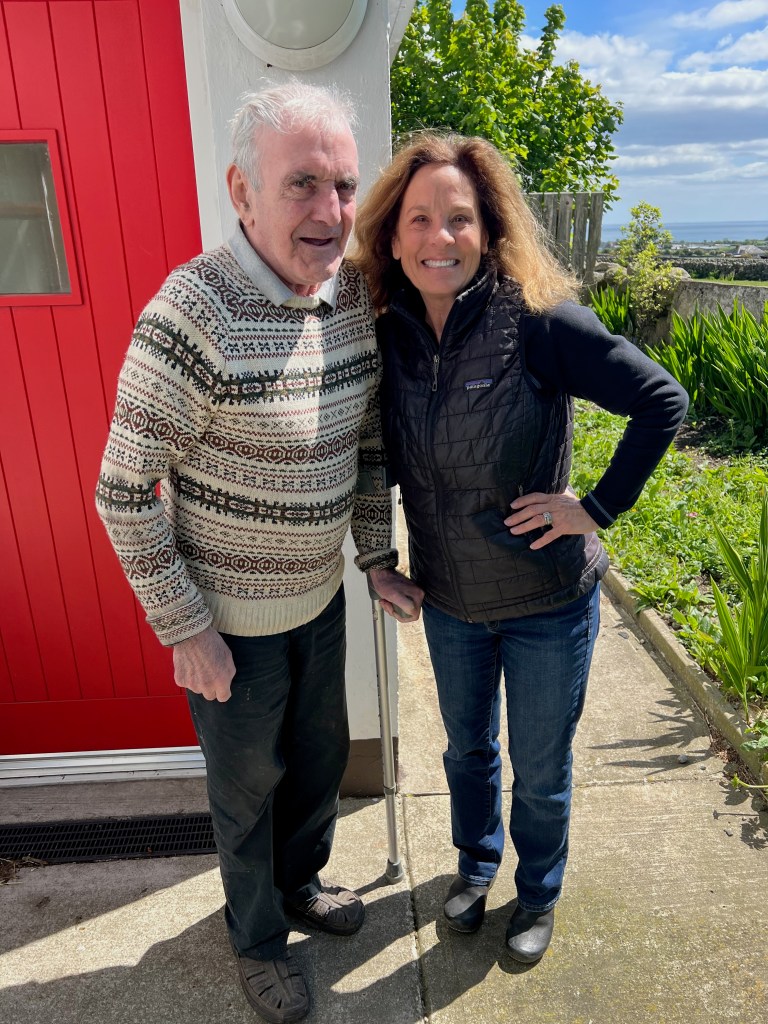
“That’s a shame”, we say. He reaches for his nebulizer, takes a hit, waits to catch his breath, then says, “But his widow lives out on Longstone Road.” We share that she must be elderly and, what with Covid and all, she may be reluctant to come to the door. He tells us “She isn’t that old; she’s ninety.”
I am better than Cathy at “interpreting” a deep Irish brogue, but I’m not certain, as he gives directions, if he is describing a stone wall lined road or using the proper name of the road. He gives us directions which neither of us can hardly understand and certainly will not remember, but we are reluctant to have him repeat himself, what with his shortness of breath.
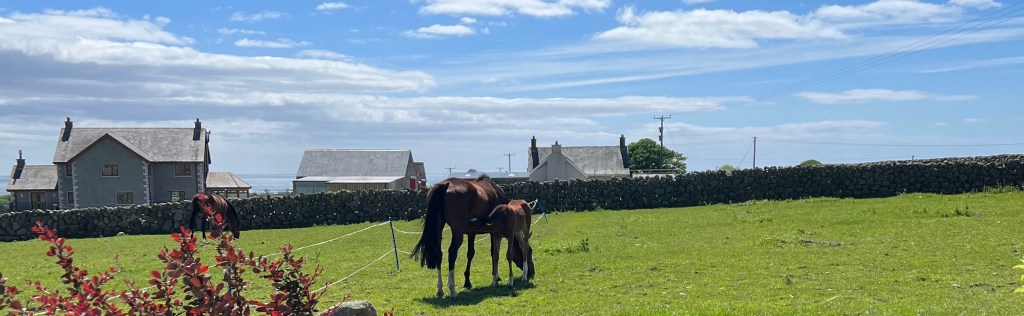
We make our way to the front door. He points out a foal of his niece and a foal of his own in the pasture next to the house. He sees Cathy knows horses, and reminds us—how true it is I don’t know and don’t really care—that a horse’s legs as a foal are as long as they will ever be. He repeats it with a smile.
We say our good-byes. He wishes us “safe journey.” Cathy pauses at the bottom of the lane as I pull up Google Maps. Turns out Longstone Road is a stone’s throw away.
We pull into a string of small shops and agree Cathy will try the ladies in the hair salon and I’ll try in the mini-mart. Cathy has a talk with a kind lady, her hair in metal foils. I chat with a nice lady behind the counter. Both tell us Leontia is on in years and point out where she lives.
We again get lost, uncertain which house matches what they described. An elderly couple is walking their dog on the lane; we stop to ask if they know where Leontia might live. They explain, almost giddy to help two Americans, that they are not from the area, but know that a granddaughter cares for an elderly woman in the house just across the street.
We ring on the bell, explain to the granddaughter why we are calling. She invites us in as if we were family. There is the living room is Leontia McKibbin and a gentleman caller.

He teases her that he is after her beauty and her wealth. She laughs silently. She allows as how about once a year “some relative from America comes visiting.” We tell him we have come from Leo. He gives a look like Leo might imbibe just a wee bit and might not to be the most reliable historian, saying “Just what did he tell ye?”
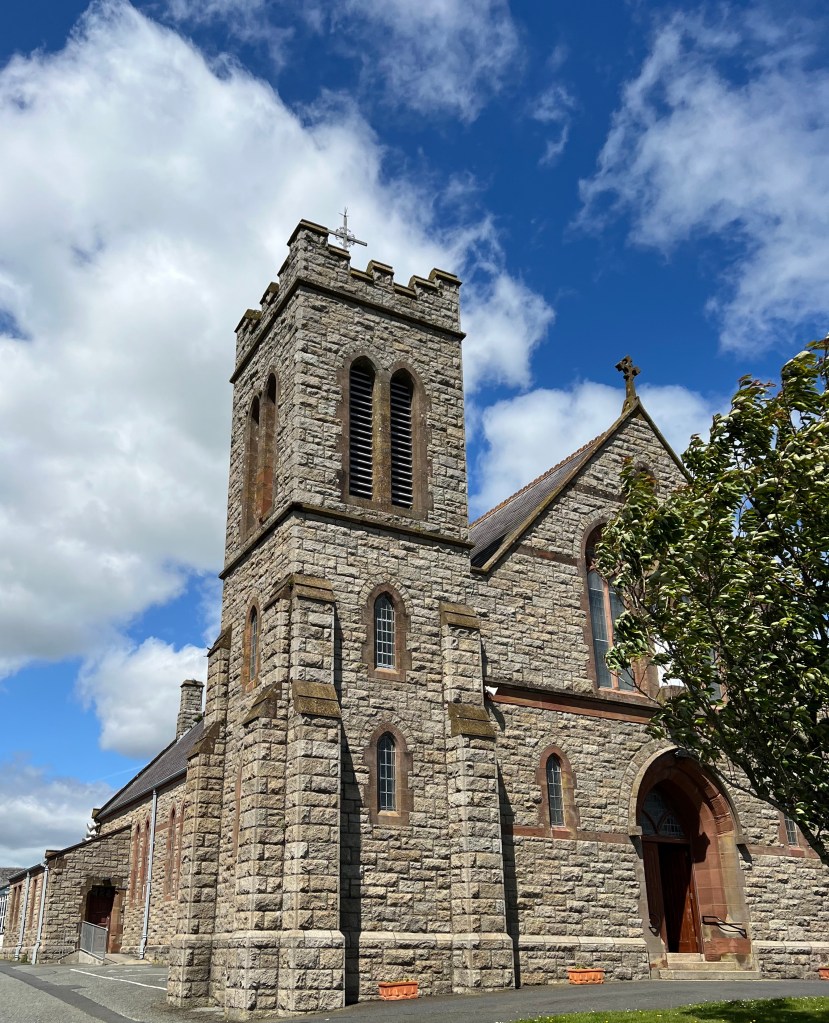
We stay for a bit and then make our way to the graveyard. (a word I find the Irish prefer to “cemetery) at St. Joseph’s Church on the coast road. We wander about, taking care not to step on a grave. The graveyard is filled with Cunninghams (another branch of Cathy’s family tree) but, try as we might, we can’t find the grave of Eddy Pat McKibbin.
Then, just at the last minute as we are walking to the car, there right in front of us rests Eddy Pat McKibbin of Longstone Road.


It’s late at the Thistlethatch. The summer solstice is near. The days are long. The sun sets well after 10:00. Cathy has spent the day hoping to find just the right spot in which to bury a copy of the letter her Grandpa wrote sixty-six years ago to Bob Paige hoping to win the Big Payoff for the woman he loved.
T.S. Elliot was right,
“We shall not cease from exploration,
and the end of all of our exploring
will be to arrive where we started
and know the place for the first time.”
Cathy found the right spot for her grandpa’s letter. It’s beneath a tea kettle, high above the Valley of the Annalong River, in the shadow of Slieve Donard and the Mourne Mountains.

 "Not All Those Who Wander Are Lost"